
Key Points:
- Insurers embed exclusions and carve-outs to avoid real pollution liabilities.
- Many claims fail due to late notice, known condition, or trigger disputes.
- Recovery often hinges on policy archaeology and skilled negotiation.
____________________________________________________________________________________________________
When a pollution incident or environmental claim arises, many policyholders assume their insurance will step in to protect them. In reality, insurers often rely on complex language, hidden exclusions, and procedural defenses to limit or deny payments. In this article, I’ll expose what insurers don’t want you to know, and show you how to fight back.
Whether you’re a property owner, business operator, or environmental professional, understanding the hidden tactics insurers use is vital. You may also find useful more about environmental claim handling, cleanup coverage, or public adjuster assistance via our environmental claims services page.
Why Environmental Risk Is Particularly Vulnerable
Environmental claims differ fundamentally from ordinary property or liability claims. Here are some key features:
- Latent damage: Pollution may remain hidden for years before discovery.
- “Trigger” complexity: Insurers try to argue the event didn’t occur in your policy period.
- Regulatory overlay: Government enforcement, cleanup orders and fines add layers of cost.
- Multi-million dollar exposure: Soil, groundwater, and remediation costs escalate fast.
The industry has evolved to incorporate these complexities into coverage designs, often in ways that favor the insurer.
Insurer Tactics: Carve-Outs, Exclusions & Silent Defenses

Insurers don’t just “fail to pay”, they build defenses in. Below are some of the most common and insidious tactics:
1. Pollution Exclusions and Absolute Exclusions
Standard commercial general liability (CGL) policies adopted pollution exclusions beginning in the 1970s. Over time, many policies include absolute pollution exclusions that remove coverage entirely for pollution-related damage.
Even if you believe a release is “sudden and accidental,” insurers often argue that the wording is ambiguous or doesn’t apply to gradual contamination.
2. Known Condition / Prior Knowledge
If contamination predated the policy or was known (or should have been known) at inception, insurers often decline coverage. This allows them to deny claims by arguing your risk was foreseeable.
3. Trigger & Timing Disputes
Insurers may argue that the “trigger”, the moment the occurrence is insured, is outside the policy’s effective dates, even if damage manifests later. They may also challenge retroactive date clauses.
4. Late Notice / Reporting Violations
Missing the claim notice deadlines, failing to report promptly, or failing to follow policy notice procedures gives insurers easy grounds to deny.
5. Failure to Cooperate or Making Unauthorized Payments
Many policies require the insured to cooperate fully and get insurer approval before making cleanup efforts. If you act unilaterally, insurers claim that you breached conditions.
6. Contractual Liability Carve-Outs
If you assume indemnity obligations by contract, insurers may exclude that liability unless the policy explicitly reinstates it.
7. Sub-limits, Caps & Sublimit Carves
Even when pollution risk is covered, insurers may impose sublimits (lesser caps) for mold, asbestos, lead, or certain media (soil, water) to restrict exposure.
8. Exclusion of Gradual or Nuisance Pollutants
Policies may distinguish between “sudden and accidental” events (covered) and gradual or non-sudden pollution. Many claims involve slow releases or seepage, then insurers say they aren’t covered.
9. “Insured vs Insured” Exclusions
Policies sometimes exclude claims where one insured sues another under the same policy, an issue in joint ventures or related entities.
10. Waste Disposal / Off-Site Exclusions
Some policies exclude liability once waste leaves your property or enters a disposal site, leaving you exposed for transport or disposal liabilities.
How Claims Are Denied in Practice

To see how theory plays out, here are real scenarios illustrating insurer defenses:
- A warehouse fire melted dairy products, which ran into a wastewater system, clogging public infrastructure. The insurer declined the claim citing pollution exclusion, even though the substance was food waste.
- A business filed a claim for old contamination discovered decades later. The insurer argued that the occurrence was outside all policy periods and no proper trigger applied.
- A policyholder made remediation payments without insurer approval. The insurer denied reimbursement, claiming breach of cooperation conditions.
These stories illustrate that even with a “clean” looking policy, insurers often prevail through legal defenses, procedural technicalities, or reinterpretation of ambiguous language. Understanding how to determine if your claim was underpaid helps you identify when insurers are shortchanging you.
How to Protect Yourself: Best Strategies & Tactics
You don’t have to be powerless. The savvy policyholder uses proactive and defensive strategies.
A. Policy Design: Negotiate for Favorable Terms
- Seek affirmative pollution coverage rather than ambiguous wording.
- Include no known conditions warranty carve-backs or insured vs insured exceptions.
- Ask for coverage of gradual/seepage pollution, not just sudden events.
- Mandate off-site waste coverage and contractual liability extensions.
- Build mold, asbestos, lead into the base coverage without sublimits.
B. Insurance Archaeology & Historical Policies
Because environmental issues may date back decades, locating older CGL policies (pre-pollution exclusion era) through insurance archaeology is critical. Reconstruction of lost policies, broker records, or archived documents may unlock latent coverage.
C. Rigorous Documentation & Response
- Always issue immediate notice to the insurer at the first hint of a claim.
- Preserve all evidence: photos, reports, correspondence, environmental tests.
- Use experienced environmental consultants and legal counsel from day one.
- Avoid unilateral remedial actions without insurer consent.
D. Use of Professional Claims Counsel / Public Adjusters
Specialist adjusters or environmental claims counsel can interpret complex policy language, demand coverage, and negotiate settlement on your terms. When should you hire a public adjuster? The answer is simple: as soon as you face a complex or contested claim.
Working with a public adjuster who understands commercial property claims ensures that business owners receive proper representation and maximum recovery.
E. Challenge Denials / Appeal & Litigation
Sometimes you must fight a denial. You may:
- Argue ambiguous clauses in your favor.
- Demand independent expert review.
- Pursue reformation or estoppel arguments if brokers misrepresented the coverage.
If your insurance company isn’t responding or denying your claim unfairly, don’t accept defeat, escalate with professional help.
F. Risk Management & Exposure Mitigation
Even before a claim, reduce exposure:
- Perform environmental audits and compliance reviews.
- Maintain spill controls, secondary containment, monitoring.
- Train employees on handling pollutants and emergency response.
- Monitor nearby sites or changes in regulation (PFAS, emerging contaminants).
Emerging Challenges & Trends in Environmental Claims
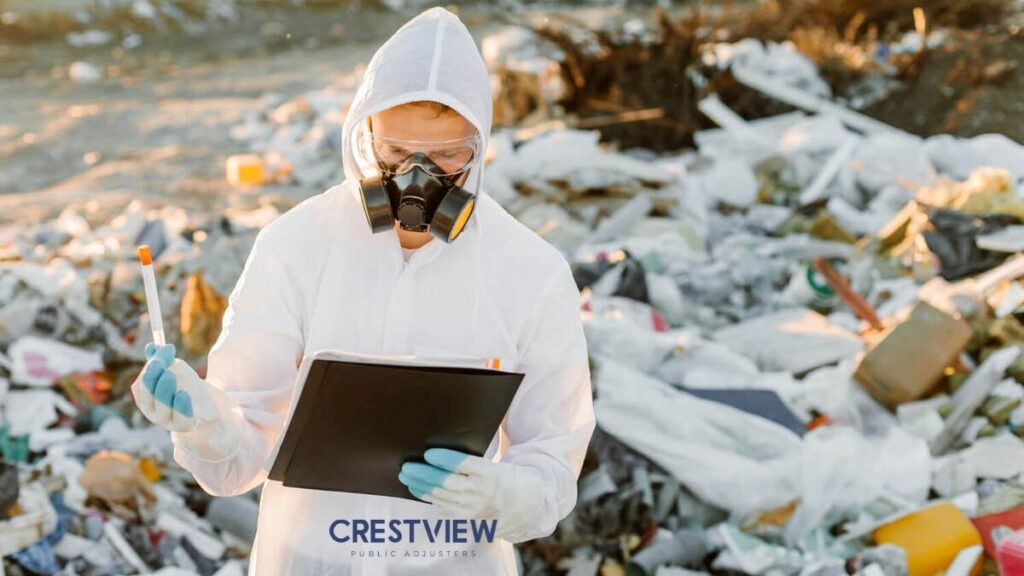
The landscape is shifting. Here are important trends to watch:
PFAS and “Forever Chemical” Risks
These persistent compounds present new liability exposure. Insurers increasingly scrutinize PFAS risk and may exclude coverage or demand special endorsements.
Greenwashing & ESG Claims
Companies face claims for misrepresenting environmental practices (“greenwashing”). Insurers may resist covering defense costs unless policy wording explicitly contemplates such risk.
Climate Change and Aggregated Risk
Insurers grapple with rising frequency of floods, wildfires, and systemic environmental losses. Many are withdrawing or excluding high-risk zones.
More Stringent Disclosure & Regulatory Pressure
Governments demand greater environmental risk disclosure. That pressure makes insurers scrutinize coverage and claim submissions more aggressively.
Reinsurance Market Tightening
As reinsurers push back on environmental exposures, primary insurers tighten underwriting, increase rates, and restrict coverage further.
The Role of Public Adjusters in Complex Environmental Claims
Environmental claims require specialized knowledge of both insurance policy language and environmental regulations. Public adjusters work exclusively for policyholders, not insurance companies, to document losses, interpret coverage, and negotiate maximum settlements.
For business owners facing environmental liabilities, the benefits of hiring a public adjuster include expert policy analysis, thorough damage assessment, and skilled negotiation that often results in significantly higher payouts.
Many policyholders wonder, “Is it a good idea to hire a public adjuster?” For complex environmental claims with substantial exposure, the answer is almost always yes. The cost of not having expert representation often far exceeds the adjuster’s fee.
Understanding Your Rights and Options
If you’re dealing with underpaid insurance claims, know that you have options. Insurance companies count on policyholders accepting low offers without question. Professional advocates level the playing field.
Understanding the complete insurance claims process helps you know what to expect at each stage and when to push back against insurer delays or denials.
FAQs
Can my insurance cover pollution caused before my policy started?
Possibly, if your policy includes a favorable retroactive date or if older occurrence-based policies are discovered through insurance archaeology.
Why do insurers exclude gradual pollution while covering sudden events?
Because gradual releases are harder to detect and price. Excluding long-term seepage reduces unpredictable exposure for insurers.
What should I do immediately when discovering contamination?
Provide prompt notice, preserve evidence, engage environmental and legal experts, and avoid unapproved cleanup until insurer agreement confirms coverage.
Uncover the Truth in Environmental Claims
Environmental damage claims, such as asbestos, mold, or contamination, are some of the most complex and heavily contested by insurance carriers. Insurers often exploit exclusions, minimize the scope of remediation, or attempt to deny responsibility outright.
Crestview Public Adjusters provides the experience needed to challenge these strategies. We compile thorough documentation, apply environmental codes and standards, and negotiate aggressively to ensure the true scope of your loss is recognized.
Our team prepares proof of loss that reflects the real costs of cleanup and restoration, safeguarding your health, property, and financial stability. Contact Crestview today to discuss your environmental claim and secure fair compensation for complex damages.