
Key Points:
- Business continuity planning connects storm damage to business income loss by documenting normal operations, physical damage, shutdown dates, and mitigation steps.
- Separate timelines for each location help show why operations stopped or slowed.
- Matching operational records with revenue reports, invoices, and extra expenses supports a clear claim calculation.
Business continuity planning helps secure a commercial storm damage claim because it creates a dated record of normal operations, the physical storm damage, and the steps you take to reduce operational downtime. A continuity plan cannot write new terms into your policy or create coverage where none exists.
However, it provides the clear evidence you need to link physical damage to a business interruption insurance claim covering lost income and extra expenses. This guide explains how to build a clear record before, during, and after a storm hits your property. Having these records ready makes it easier to prove your losses to an insurance adjuster.
How Business Continuity Planning Changes a Commercial Storm Claim
Repair estimates tell only part of the story. A commercial storm damage claim must also show how the damaged property affected the business. The result may include a full shutdown, reduced capacity, lost sales, canceled work, or added costs.
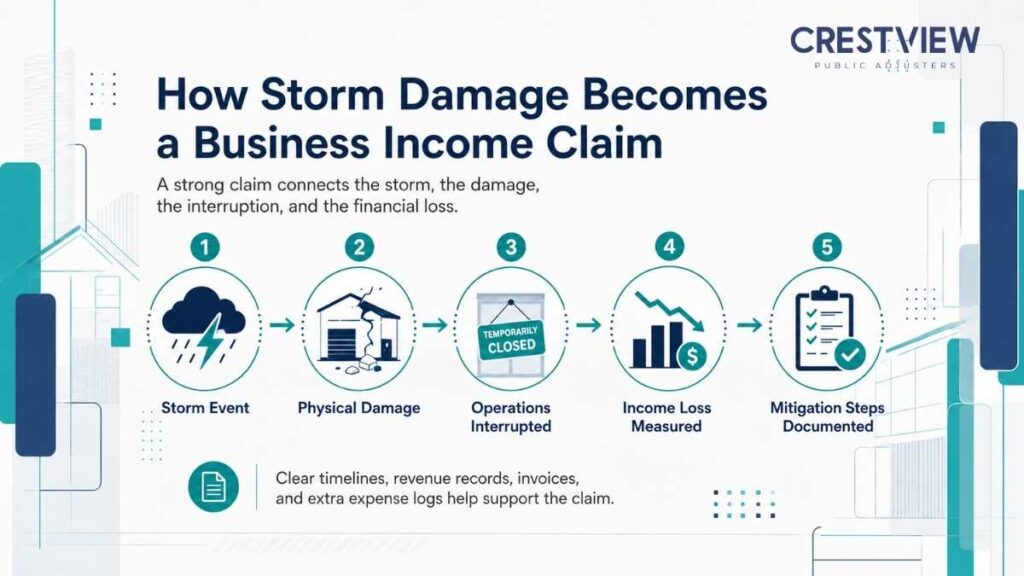
The policy controls insurance coverage for the business, while the continuity plan supplies operational evidence for this sequence:
- A covered storm event occurred.
- Physical property, inventory, or equipment sustained damage.
- The damage interrupted a specific business function.
- The interruption caused a measurable financial loss.
- The business took reasonable steps to reduce the loss.
The National Association of Insurance Commissioners explains that business interruption coverage usually works with commercial property coverage after covered physical damage suspends operations. It also cites a Federal Emergency Management Agency estimate that about 25% of businesses fail to reopen after a disaster.
A Pre-Storm Operating Baseline Gives the Claim a Starting Point
To prove what you lost during a storm, you must first prove what your business looked like on an ordinary day. Commercial disaster prep records should show how the business normally operates, rather than serving as a generic emergency checklist. You need a documented baseline of your daily operations before any disaster strikes.
Your baseline records should include:
- Operating schedules and staffing levels for each department.
- Average daily or weekly sales, appointments, and transactions.
- Key equipment required to keep each department running.
- Schedules for major suppliers, utility connections, and delivery routes.
- Prior photos and maintenance logs to support commercial property protection evidence.
These ordinary business records serve as direct claim proof. Operating schedules establish your normal capacity, while revenue reports help calculate business income loss. Equipment lists connect damaged property to stopped services. Prior maintenance logs and photos prove the pre-storm condition of your building, showing the insurer that the damage came from the storm and not from neglect.
The Storm-to-Shutdown Timeline Links Physical Damage to Lost Income
An insurance adjuster wants to see a clear timeline that connects the natural disaster and business interruption to your closed doors. If you have several business locations, you should keep separate timelines for each property.
How Business Continuity Planning Proves the Interruption Was Storm-Related
Your log must record specific, dated events:
- The exact date and time the storm reached your property.
- The time you discovered physical damage to walls, roofs, or inventory.
- The moment operations stopped or slowed down because of that damage.
- The dates of any civil authority evacuation orders or regional access restrictions.
- The dates you restored utility services or reopened on a temporary basis.
You must separate the distinct causes of your shutdown. A closure caused directly by water pouring through a broken roof is different from a closure caused by a regional blacked-out grid.
For utility issues, your log should detail your power outage strategies, including when generators were started, battery backup limits, and utility company restoration notices. Keep all supporting records, including email alerts, text messages between managers, security system logs, and utility restoration notices. These records prevent the insurer from claiming your shutdown was voluntary or unrelated to the storm.

Mitigation Decisions Show How the Business Limited Its Loss
Commercial policies require you to take reasonable steps to prevent further damage after a storm. Your actions during and after the storm play a major role in how a public adjuster who helps with commercial property claims evaluates your business income.
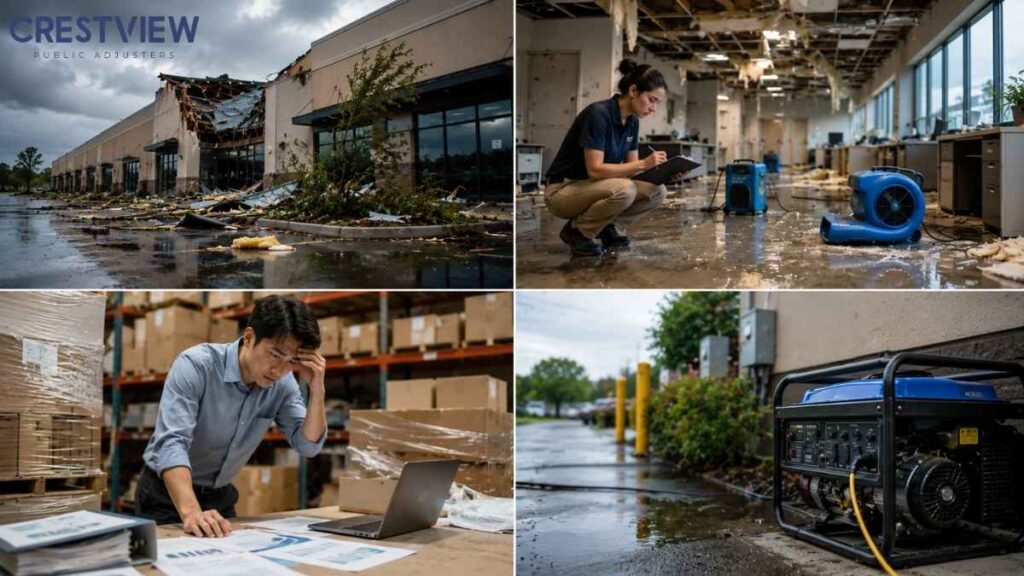
Your documentation should show active storm damage prevention steps and mitigation actions. These include:
- Boarding up broken windows or placing tarps on a damaged roof.
- Hiring water extraction services to dry out wet drywall and flooring.
- Renting generators or specialized equipment to keep vital systems running.
- Paying overtime to staff to clean up or speed up the reopening process.
- Moving operations to an alternate site or setting up remote work.
For every decision, keep a record of the date, the person who approved it, the business reason, and the invoice. Some owners worry that staying partially open will cause the insurer to reduce their payout.
In reality, partial operations are expected because you must try to reduce your losses. You simply need to document your reduced capacity, lost sales, and the added expenses you paid to stay open.
Protect Your Business Records Today
A storm timeline becomes harder to reconstruct as employees return to work, which is often when it helps to involve a public adjuster, and records move between departments. At Crestview, we can review your policy, the physical damage, continuity logs, extra expenses, and income records while the facts remain available. Our team can help organize the claim before conflicting dates or missing records slow down your recovery.
Operational Records Must Match the Business Income Calculation
Your financial records must align perfectly with your operational timeline. To build a strong claim, you must calculate expected revenue based on normal times, track actual revenue during the interruption, and separate continuing expenses from those that stopped.
A common mistake is assuming that a claim ends the moment you turn the open sign back on. A 2024 study published in Jàmbá: Journal of Disaster Risk Studies found that while 90% of surveyed businesses reopened six months after flooding, most continued to operate at a loss. Reopening a property does not mean your revenue has recovered.
Consider how this looks in practice:
- A Hackensack restaurant may reopen its dining room, but its damaged kitchen operates at half capacity.
- A Brooklyn retailer may reopen the storefront, but storm-damaged inventory remains unavailable for weeks.
- A warehouse working with a public adjuster in Philadelphia may resume shipping, but one major loading area remains closed.
These operational bottlenecks limit your revenue. Your records must show these differences so you can claim the full financial loss.
Planning Gaps Can Weaken an Otherwise Supported Claim
Even a detailed plan can fall short if it contains critical record-keeping gaps. Reviewing these risk management tips can help you avoid common documentation errors that insurers use to delay claims.
Watch out for these common planning gaps:
- Using outdated plans that list employees or equipment that no longer exist.
- Failing to record the exact shutdown and reopening times.
- Grouping multiple causes of downtime together instead of separating utility outages from structural damage.
- Describing partial operations without giving exact percentages.
- Mixing normal operating costs with emergency mitigation expenses.
- Letting employees communicate via personal texts that the company cannot retrieve.
Keep your original continuity files unchanged. If you update your plan after a storm, save it as a new version with a separate date. Never present a rewritten plan as a pre-loss record.

FAQs About Business Continuity Planning
Can my claim still succeed if the continuity plan was never tested?
Yes. A test is helpful, but your claim depends on the policy, the physical damage, and the available evidence. While a written plan shows your expected procedures, you must use financial records, employee logs, and invoices to prove what did happen after the storm.
Should each business location have a separate storm-loss timeline?
Yes. Physical damage, operating capacity, revenue, and repair dates will differ by location. Keeping separate timelines prevents one property’s records from distorting the financial calculation or recovery period of another property, making the claim easier for the insurer to evaluate.
Can a public adjuster start before the final repair estimate is ready?
Yes. A public adjuster can review the policy, collect continuity records, and analyze business income while contractors prepare repair estimates. Starting early preserves critical operational evidence and helps resolve potential documentation issues before the insurance company requests it.
Prepare Your Claim with Professional Support
Business continuity records can connect the storm, physical damage, operational decisions, downtime, and income loss in one supported claim timeline.
At Crestview Public Adjusters, we help businesses in New York, New Jersey, Pennsylvania, Florida, and other licensed states prepare commercial storm and business interruption claims. Call us now or submit our online claim form for a free assessment, and our team will review the policy, damage, and loss records with you.