Key Points:
- Public adjusters work for policyholders, ensuring they get fair insurance claim payouts, while private adjusters typically refer to independent or company-employed adjusters who work for the insurer.
- Public adjusters handle complex claims, negotiate higher settlements, and relieve policyholders of the claims process burden.
- Understanding the distinction between these roles helps policyholders avoid potential conflicts of interest and secure the best possible claim outcome.
What Is a Private Adjuster?
“Private adjuster” isn’t an official license type, so people use it in two different ways:
- An adjuster you hire privately to work for you. That’s a public adjuster, a licensed professional who represents the policyholder, not the insurance company.
- An adjuster who works for the insurance company, either as an employee (a company or staff adjuster) or as a hired contractor (an independent adjuster).
The key question isn’t the title, it’s who pays the adjuster and whose interests they protect. If you want someone working only for you, you’re looking for a licensed public adjuster.
Public vs Independent vs Company Adjuster at a Glance
| Public Adjuster | Independent Adjuster | Company (Staff) Adjuster | |
|---|---|---|---|
| Works for | You, the policyholder | The insurance company (as a contractor) | The insurance company (as an employee) |
| Who pays them | You, through a percentage of the settlement | The insurer | The insurer |
| Main goal | Maximize your settlement | Assess the claim for the insurer | Settle the claim for the insurer |
| Licensed by the state | Yes | Yes, in most states | Varies by state |
| Negotiates for you | Yes | No | No |
A public adjuster represents the policyholder, advocating for maximum claim payouts from the insurance company. A private adjuster, often called an independent or company adjuster, works for the insurance provider to assess claims and minimize payouts. Public adjusters protect your financial interests, while private adjusters prioritize the insurer’s bottom line.
Many homeowners and business owners are unaware that insurance companies have their own adjusters to protect their interests—not yours. If your claim is large or complex, hiring a public adjuster ensures you have an expert working solely for you, negotiating a fair settlement based on actual damages and policy coverage.
Who Do Public and Private Adjusters Work For?
Insurance claims can be stressful, especially when navigating policy terms, damage assessments, and negotiations. One key factor influencing your claim’s outcome is who the adjuster works for—you or the insurance company.
Public Adjusters: Your Advocate
Public adjusters are licensed professionals hired by policyholders to represent their best interests in an insurance claim. Their primary role is to:
- Evaluate property damage and losses accurately.
- Review your insurance policy to maximize claim potential.
- Handle negotiations with the insurance company to secure the best possible payout.
Since they work exclusively for you, public adjusters are motivated to ensure you receive the full amount you’re entitled to—not a reduced payout dictated by the insurer.
Private Adjusters: The Insurer’s Representative
The term “private adjuster” often refers to either:
- Independent adjusters—third-party professionals hired by the insurance company.
- Company adjusters—full-time employees working directly for the insurer.
Both types have one thing in common: they work for the insurance provider, not you. Their goal is to assess damages while keeping claim payouts low to protect the company’s financial interests. While they may seem helpful, their assessments often favor the insurer.
Why Should You Hire a Public Adjuster?
Insurance policies are complex, and claim settlements can make or break your financial recovery after property damage. A public adjuster levels the playing field, ensuring your claim is handled correctly and fairly.
Benefits of Hiring a Public Adjuster
- Higher payouts – Studies of Florida claims have found that policyholders who used a public adjuster often received significantly larger settlements than those who didn’t. Results vary by claim, but professional documentation and negotiation usually make a real difference.
- Expert Damage Assessment – Public adjusters conduct thorough inspections to identify hidden damages that insurers might overlook.
- Claim Process Management – Handling paperwork, deadlines, and negotiations can be overwhelming. A public adjuster takes care of everything, ensuring no critical steps are missed.
- Dispute Resolution – If your insurer underestimates your claim, a public adjuster fights back with documented evidence to justify a higher payout.
- Saves You Time and Stress – Instead of dealing with the insurer’s back-and-forth, you can focus on rebuilding while the public adjuster handles your case.
Without a public adjuster, many policyholders accept lower payouts due to lack of experience or pressure from the insurer’s adjuster.

Can a Public Adjuster Get You a Bigger Insurance Payout?
Yes. Public adjusters have a strong track record of securing higher settlements for policyholders. Their in-depth knowledge of insurance policies, combined with accurate damage assessments and negotiation skills, helps maximize claim payouts.
Factors That Influence Higher Payouts:
- Detailed Claim Documentation – Public adjusters ensure all damages are accounted for, preventing insurers from undervaluing your losses.
- Professional Negotiation – With experience handling insurance companies, they know how to counter lowball offers effectively.
- Policy Interpretation Expertise – Public adjusters understand policy loopholes and coverage extensions that may entitle you to a higher claim amount.
Working with a public adjuster, you increase your chances of receiving a fair and comprehensive payout—one that truly reflects your damages.
When Should You Hire a Public Adjuster?
Hiring a public adjuster makes sense in several situations, especially when dealing with complex or high-value claims. If you’re uncertain about your insurance company’s offer, bringing in a public adjuster can prevent underpayment or denied claims.
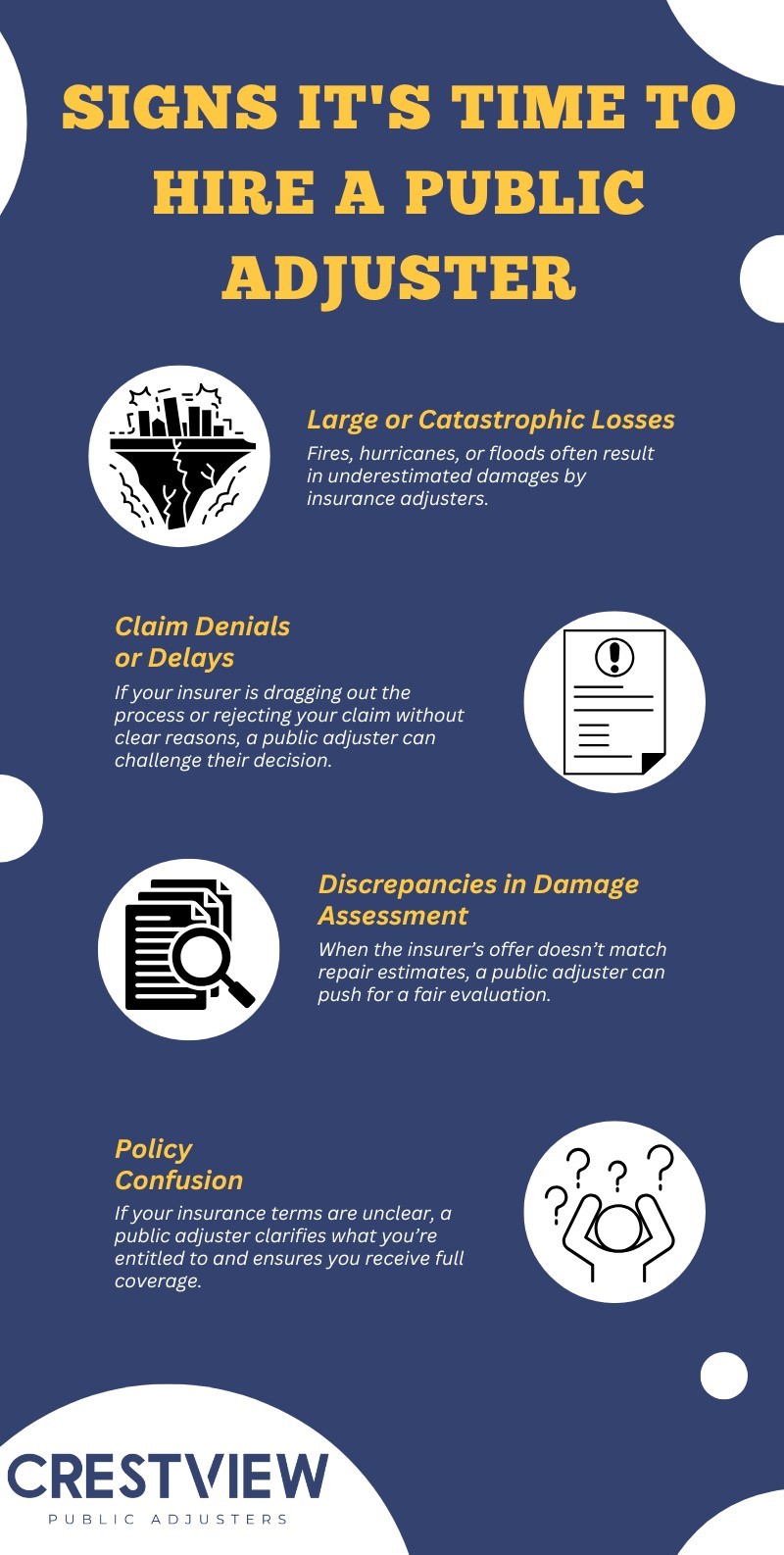
Consider a public adjuster if:
- Your claim is large or complex, such as fire, flood, hurricane or major water damage.
- The insurer’s offer seems too low or doesn’t cover your repair estimates.
- Your claim was denied or delayed without a clear reason.
- You’re dealing with business interruption or commercial losses.
- You don’t have the time or expertise to handle documentation and negotiation.
- Your claim involves multiple policies, such as a condo unit policy and the building’s master policy.
If any of these apply to you, consulting a public adjuster early can make a significant difference in your claim’s outcome.
Are Public Adjusters Worth the Cost?
Yes, especially if your claim is substantial. Public adjusters typically charge a percentage of the final settlement, agreed in writing before work begins. New York, New Jersey and Florida each regulate public adjuster fees, and Florida caps them, with lower caps after declared emergencies.
Especially if your claim is substantial. Public adjusters typically charge a percentage of your final payout, usually between 5% and 15%. While this may seem like an added cost, it’s often offset by the higher payout they secure for you.
How Public Adjusters Save You Money:
- They prevent lowball settlements from the insurance company.
- They uncover hidden damages that insurers may ignore.
- They negotiate every aspect of your claim, ensuring no money is left on the table.
For large claims, the difference in payout with a public adjuster can be tens of thousands of dollars—making their fee well worth the investment.
Frequently Asked Questions
Is a private adjuster the same as a public adjuster?
Sometimes. People often say “private adjuster” when they mean an adjuster they hire themselves, which is a public adjuster. Others use it for independent adjusters who work for the insurance company. Always ask who the adjuster represents.
Does a private adjuster work for me or the insurance company?
An independent or company adjuster works for the insurance company. A licensed public adjuster works only for you, the policyholder.
Can I hire my own adjuster for an insurance claim?
Yes. You can hire a licensed public adjuster at any point in the claim to inspect the damage, prepare your claim and negotiate with the insurer for you.
How much does a private or public adjuster cost?
Public adjusters usually charge a percentage of the settlement, with no upfront fees, and state law regulates those fees. Independent and company adjusters are paid by the insurer, so there’s no direct cost to you, but they don’t represent your interests.
Secure Your Insurance Claim with a Public Adjuster
Navigating an insurance claim alone can be overwhelming—especially when the insurer’s adjuster is working against you. A public adjuster ensures you get every dollar you’re entitled to, without the stress of fighting insurance companies.
Crestview Public Adjusters specializes in maximizing insurance claims for homeowners and businesses in Florida, New Jersey, and New York. Whether you’re facing a denied claim, a low settlement, or need guidance, our experienced public adjusters are here to fight for your rightful payout.Don’t leave money on the table—contact Crestview Public Adjusters today and get the settlement you deserve.