
Key Points:
- A Proof of Loss is a critical legal document required in most property insurance claims.
- Submitting a complete and accurate Proof of Loss can significantly impact the outcome and speed of your claim.
- Many claims are denied or delayed due to missing, late, or incorrect Proof of Loss forms.
Many policyholders assume that reporting a loss is enough, but without this essential document, insurers often delay or outright reject the claim. That’s why understanding what a Proof of Loss is and why it matters is so important, especially for homeowners and business owners navigating the often-confusing insurance process.
What Is a Proof of Loss and Why It Matters?
A Proof of Loss is a formal statement you submit to your insurance company after experiencing a covered loss, such as fire, water damage, theft, or storm damage. It includes detailed information about the incident and a valuation of the damages.
Without submitting a properly completed Proof of Loss, most insurance companies will not move forward with processing your claim. It’s not just a formality—it’s a legal requirement in many cases, and it can make or break your financial recovery after a disaster.
Why Do Insurance Companies Require a Proof of Loss?
It’s not just about red tape. The Proof of Loss gives insurers the necessary documentation to validate your claim and determine how much they are obligated to pay. It’s also your opportunity to present your side of the story—backed by numbers, receipts, and evidence.
Without it, the insurer doesn’t have the full picture. And worse, they could dispute or undervalue the claim. Here’s why this document is essential:
- Legal obligation: Most policies have a clause that requires it within a specific time frame.
- Accuracy of payout: The insurer uses it to verify your loss amount.
- Fraud prevention: It ensures claims are legitimate and documented.
Failing to provide this document, or submitting it with errors, can jeopardize your ability to collect any compensation at all.
What Should Be Included in a Proof of Loss?
While each insurer may have slightly different forms or formats, the general components of a solid Proof of Loss include:
- Date and cause of the loss
- Full inventory of damaged or lost items
- Estimated value of the damages
- Documentation or evidence (photos, receipts, appraisals)
- Policyholder signature under oath
The more detailed and accurate your information, the stronger your position will be. Always cross-reference your insurance policy to ensure you meet all the documentation requirements.
When Is a Proof of Loss Required?
Most standard property insurance policies specify when a Proof of Loss must be submitted. Timing is crucial. You typically need to file this document within 60 days of the loss, though some policies allow as few as 30 days or up to 90 days.
Miss this deadline, and your insurer might legally deny the claim—regardless of its merit.
Common scenarios requiring a Proof of Loss include:
- Fire damage to home or business
- Storm or flood-related destruction
- Theft or vandalism
- Water or mold damage
- Business interruption claims
Don’t wait for the insurer to request it. Some policies place the burden of submission on the policyholder without prompt.

How Can Errors in Proof of Loss Delay or Deny Your Claim?
Even small mistakes can cause significant delays when filing an insurance claim. Incomplete forms, underreported losses, or unsupported valuations often raise red flags with insurers. Errors such as inconsistent valuations can trigger suspicion and lead to audits, while missing documentation creates gaps that delay processing. Submitting your claim late may give the insurer valid grounds for denial, and misstated facts can even result in accusations of fraud. Insurance adjusters frequently scrutinize discrepancies between the Proof of Loss and other submitted documents, and if inconsistencies arise, they may interpret them as signs of negligence or intentional misrepresentation.
What Happens After You Submit a Proof of Loss?
Once you’ve submitted your Proof of Loss, your insurance company will typically review the documentation to confirm that it meets policy requirements, send their own adjuster to inspect the damage and validate your claim, negotiate the payout amount based on your reported loss and their assessment, and ultimately issue a payment or a denial depending on their findings. This process can take anywhere from a few weeks to several months, which is why it’s critical to ensure your Proof of Loss is both comprehensive and accurate from the beginning.
Can You Amend a Submitted Proof of Loss?
Yes, but only under certain conditions. You can usually file a revised Proof of Loss if you discover errors or need to add more information. However, you must do this before the claim is settled or denied.
Timing again plays a crucial role. Some insurance companies allow amendments only within the original deadline. Others may require a formal written request and explanation for the changes.
Submitting a revised form:
- Clearly mark it as a revision.
- Include updated documentation.
- Attach a letter explaining the corrections.
Be proactive. If your losses evolve (e.g., additional mold damage discovered weeks after a flood), it’s your responsibility to alert your insurer and supplement your claim.
What If the Insurance Company Disputes Your Proof of Loss?
Disputes are common, especially in large or complex claims. Insurers may claim:
- Your valuation is inflated.
- Your documentation is insufficient.
- The loss is not fully covered under your policy.
If that happens, don’t panic—but don’t go it alone, either. Consider hiring a Public Adjuster to advocate on your behalf. These professionals specialize in preparing and negotiating claims from the policyholder’s perspective—not the insurance company’s.
How Can a Public Adjuster Help With a Proof of Loss?
Public Adjusters take on the responsibility of assembling, submitting, and defending your Proof of Loss. Their experience often results in higher settlements and faster processing times.
They help by:
- Assessing your actual damages accurately
- Preparing a strong and compliant Proof of Loss
- Negotiating directly with your insurer
- Avoiding common pitfalls that delay or reduce claims
If you feel overwhelmed by the paperwork or suspect your insurer is undervaluing your loss, involving a Public Adjuster can significantly shift the odds in your favor.
Who Should Prepare the Proof of Loss—You or a Professional?
While it’s technically the policyholder’s responsibility to file the Proof of Loss, doing it yourself isn’t always the best option—especially if your claim is complex or large in scale. Involving a professional can be crucial if you’re dealing with multiple types of damage, such as fire and water, if the insurer is slow or unresponsive, if the initial adjuster’s offer seems too low, or if you’re unsure what documentation to include. While you can handle a basic Proof of Loss on your own, keep in mind that this document is a legal declaration, and filing it with errors can lead to serious legal and financial consequences. When in doubt, it’s wise to work with someone who knows the process inside and out.
Final Thoughts on What Is a Proof of Loss and Why It Matters
Filing a Proof of Loss may seem like just another step in an already stressful claims process. But it’s far more than just a form—it’s a pivotal moment in securing the payout you deserve.
Understanding what is a Proof of Loss and why it matters helps you take control of your claim. It ensures that your loss is fully recognized, properly documented, and accurately valued. Whether your claim is for a minor repair or a major rebuild, this document can determine whether your recovery goes smoothly—or stalls indefinitely.
Key Elements to Include When Preparing Your Proof of Loss
Preparing a thorough Proof of Loss requires attention to detail and a clear understanding of what your insurer expects. While every policy and insurer might have slightly different requirements, these key elements are universally important to ensure your submission is complete and effective:
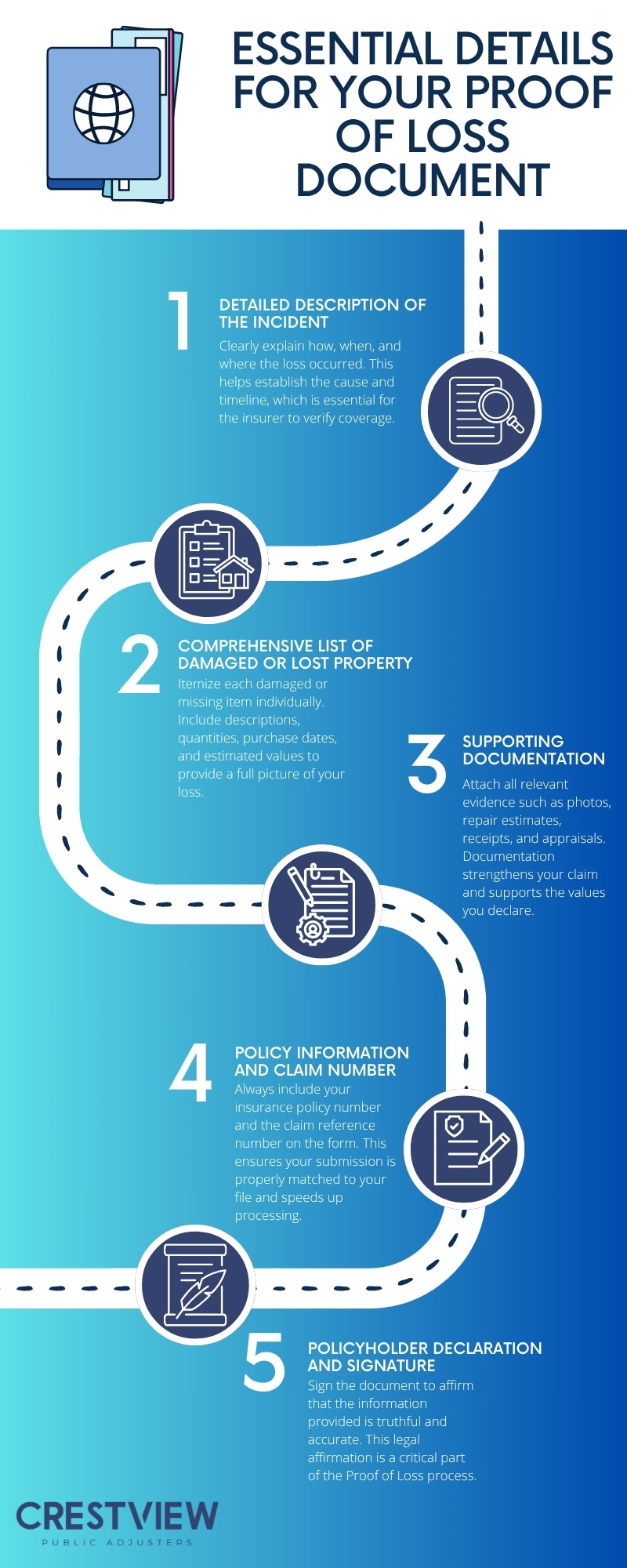
Including these elements will improve the clarity and credibility of your claim, reducing the chances of delays or disputes over your Proof of Loss.
Get Expert Help With Your Insurance Claim
Don’t let paperwork derail your claim. If you’re unsure how to complete a Proof of Loss or if your insurer is dragging their feet, Crestview Public Adjusters can help. Our team knows exactly how to protect policyholders and secure fair settlements—no guesswork, no delays.
We serve clients in Florida, New York, and New Jersey, and we’ve helped countless homeowners and business owners recover from losses efficiently and confidently.
Let us handle the paperwork—so you can focus on rebuilding. Reach out to Crestview Public Adjusters now and get the expert support your claim deserves.