
Key Points:
- Insurance companies often underpay or deny winter damage claims due to policy exclusions, alleged maintenance issues, or insufficient documentation.
- Common reasons for denial include disputes over the cause of damage, pre-existing conditions, or missed deadlines.
- Understanding policy terms, maintaining detailed records, and seeking professional help can significantly improve your claim outcome.
Each year, winter weather causes billions in property damage across the U.S. Yet many homeowners are shocked when their winter damage claims are underpaid—or worse, denied outright. Why does this happen so often, and what can you do about it? Let’s break it down.
Why Winter Damage Claims Are Often Underpaid or Denied
Winter damage claims are often underpaid or denied because insurers argue that the damage stems from maintenance issues, excluded events, or insufficient proof. Adjusters working for insurance companies may interpret policy terms in ways that limit payouts or reject claims altogether, leaving policyholders to cover costly repairs on their own.
What Makes Winter Damage Claims So Contentious?
Winter damage can be complex. The same storm that causes roof collapse from heavy snow might also lead to frozen pipes, ice dams, or interior water damage. Insurers often scrutinize these claims for ways to limit liability.
One major factor is ambiguity over the cause of damage. Insurance policies cover sudden, accidental events—but if the insurer argues the damage resulted from neglect or gradual deterioration, your claim could face denial or significant reductions. This is especially common in cases involving:
- Ice dams: Insurers may say they formed because of poor insulation or ventilation, making it a maintenance issue.
- Frozen pipes: Claims could be denied if the insurer argues you didn’t adequately heat or insulate the property.
- Roof collapse: The insurer might point to pre-existing structural weaknesses.
These disputes are often subjective, depending on how the insurer’s adjuster interprets evidence.

What Are the Top Reasons Claims Are Denied or Underpaid?
Insurance companies don’t arbitrarily deny claims—there are patterns in why they push back. Here’s where things often go wrong for policyholders:
Alleged Lack of Maintenance
Insurers commonly deny claims on the grounds that damage resulted from neglect rather than a sudden event.
- Ice dams blamed on poor attic insulation or ventilation.
- Frozen pipes linked to failure to maintain heat.
- Roof leaks attributed to wear and tear.
Insurers often send their own adjusters or engineers to support these conclusions.
Policy Exclusions and Fine Print
Winter damage claims may fall into gaps in your coverage.
- Some policies exclude damage from ice dams altogether.
- Certain water damage may only be covered if the pipes burst inside the home, not outside.
- Snow weight exclusions may apply to outbuildings or older structures.
Understanding your specific policy language is key to avoiding surprises.
Documentation Issues
Without detailed, timely evidence, insurers have room to dispute your claim.
- Lack of photos of the damage right after the incident.
- No receipts for emergency repairs or mitigation efforts.
- Gaps in maintenance records.
Solid documentation can make or break your case.
Missed Deadlines
Every policy has strict requirements on when and how to file a claim.
- Some require notice “promptly” or “within a certain number of days.”
- Delays can give insurers a reason to deny, arguing they couldn’t properly investigate.
Even honest delays—due to being overwhelmed or displaced—can hurt your claim.
How Can You Strengthen Your Winter Damage Claim?
Dealing with winter damage is stressful enough without battling your insurance company. To protect yourself:
- Document everything: Take clear photos and videos of damage as soon as it’s safe. Keep receipts for repairs or mitigation.
- Review your policy before you need it: Understand what’s covered and what’s not. Look for exclusions that could affect you.
- Act fast: Report the damage and file your claim promptly.
- Mitigate further damage: Insurance requires you to take reasonable steps to prevent things from getting worse (e.g., shutting off water, covering openings).
If you’re already facing a denied or underpaid claim, professional help can make a huge difference.
Why Do Policyholders Need Public Adjusters for Winter Damage Claims?
Winter claims often become complicated disputes over cause and coverage. Public adjusters work solely for the policyholder—not the insurance company. Unlike the insurer’s adjuster, a public adjuster’s goal is to maximize your payout under your policy’s terms.
Here’s how they help:
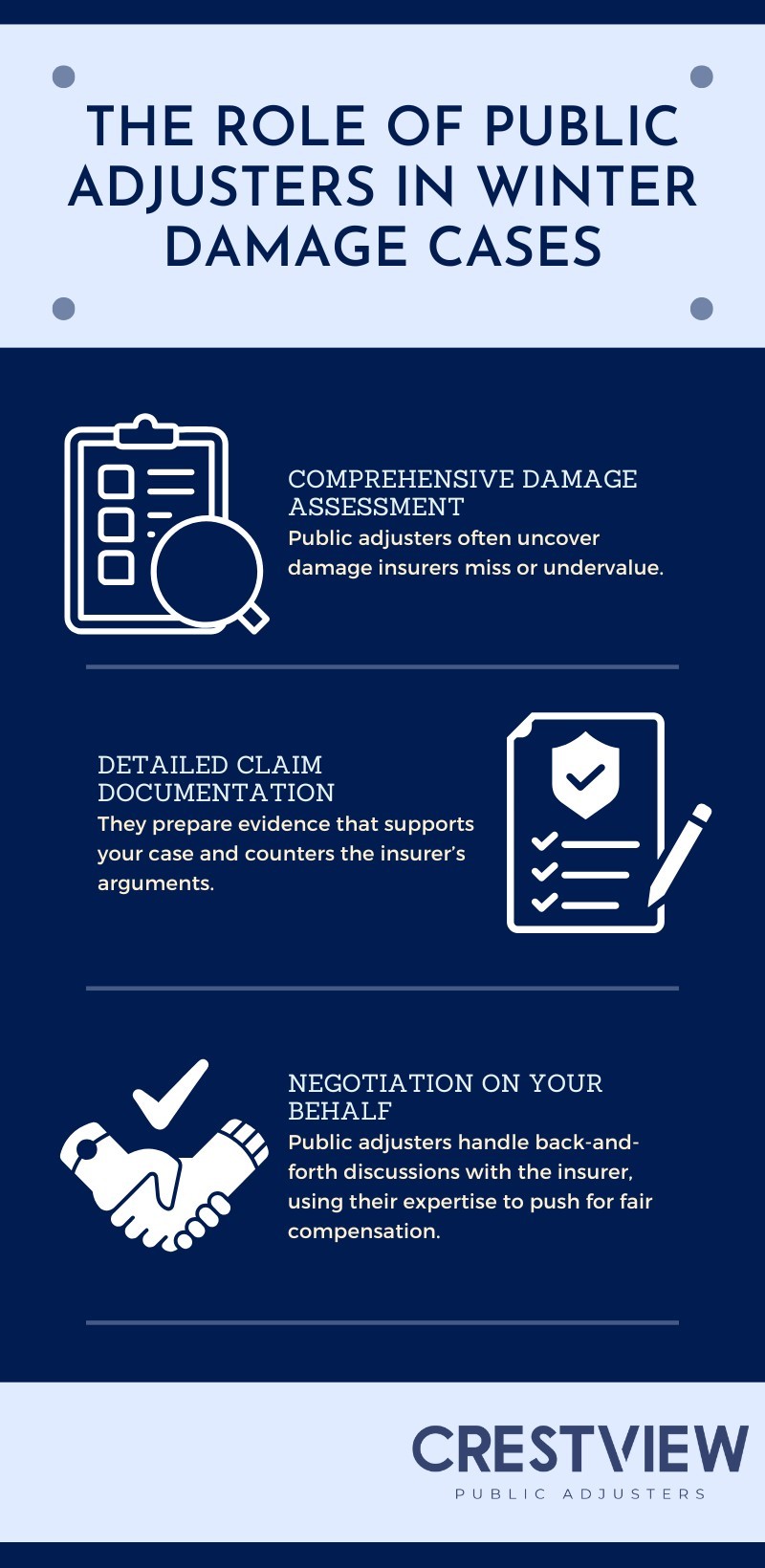
Policyholders often lack the time, experience, or emotional bandwidth to take on a claim battle during an already difficult time. That’s where skilled representation matters.
What Can You Do If Your Winter Damage Claim Is Denied?
A denial doesn’t have to be the end of the road. If your winter damage claim was denied:
- Request a written explanation from your insurer. They must provide specific reasons.
- Review the denial carefully against your policy terms.
- Consult a public adjuster or attorney for an independent opinion on your options.
- Appeal the decision or file a formal dispute if warranted.
Sometimes a denial is based on a misunderstanding or incomplete evidence—both of which can be challenged successfully.
Why Winter Damage Claims Are Often Underpaid or Denied
Handling winter storm claims often means facing insurance companies that are quick to protect their bottom line. Why winter damage claims are often underpaid or denied comes down to complex policy language, subjective cause determination, and documentation gaps. But that doesn’t mean you have to accept an unfair result. The right preparation and professional help can level the playing field.
Get the Help You Deserve—Work With Experienced Public Adjusters
Winter damage claims are too important to leave to chance. If you’re in New Jersey, Florida, or New York, Crestview Public Adjusters can advocate for you from start to finish. Our team focuses on getting homeowners and business owners fair compensation for winter damage claims. Don’t go it alone—contact us today and let us help secure the payout you need to recover.