
Key Points:
- Properly documenting winter storm damage with clear photos, videos, and notes strengthens your insurance claim.
- Timely reporting and organized records help avoid delays or denials from insurers.
- A public adjuster can help ensure no critical detail is overlooked during documentation.
Data from the Insurance Information Institute shows that winter storms caused almost $6 billion in insured losses throughout the United States in 2022. Despite this, thousands of property owners struggle to secure fair settlements simply because they fail to document damage correctly. In this article, we’ll break down how to document winter storm damage for a strong claim so you can protect your rights as a policyholder.
How to Document Winter Storm Damage for a Strong Claim
The key to documenting winter storm damage for a strong claim is to gather detailed, time-stamped evidence—photos, videos, and written descriptions—of all damage as soon as it is safe to do so. This includes external and internal property damage, contents loss, and even temporary repairs made to prevent further harm.
Failing to capture accurate records can weaken your claim, as insurance companies often request proof that the damage resulted directly from the storm rather than pre-existing issues or deferred maintenance.
Why Does Proper Documentation Matter?
Insurance companies don’t take your word for it. They need concrete evidence that the winter storm—not wear and tear—caused your losses. When damage is not thoroughly recorded, claims are more likely to be delayed, underpaid, or denied altogether.
A well-documented claim helps:
- Demonstrate the extent and cause of damage clearly.
- Speed up the adjuster’s evaluation process.
- Maximize the settlement you’re entitled to.
Many policyholders don’t realize that even minor details, like water stains or small cracks, could signal significant structural issues. Without proper documentation, these might not be covered.
What Evidence Should You Gather After a Winter Storm?
Once the storm passes and it’s safe to inspect your property, your documentation process should be thorough and systematic. Avoid general descriptions and instead focus on specific, measurable facts.
Start by:
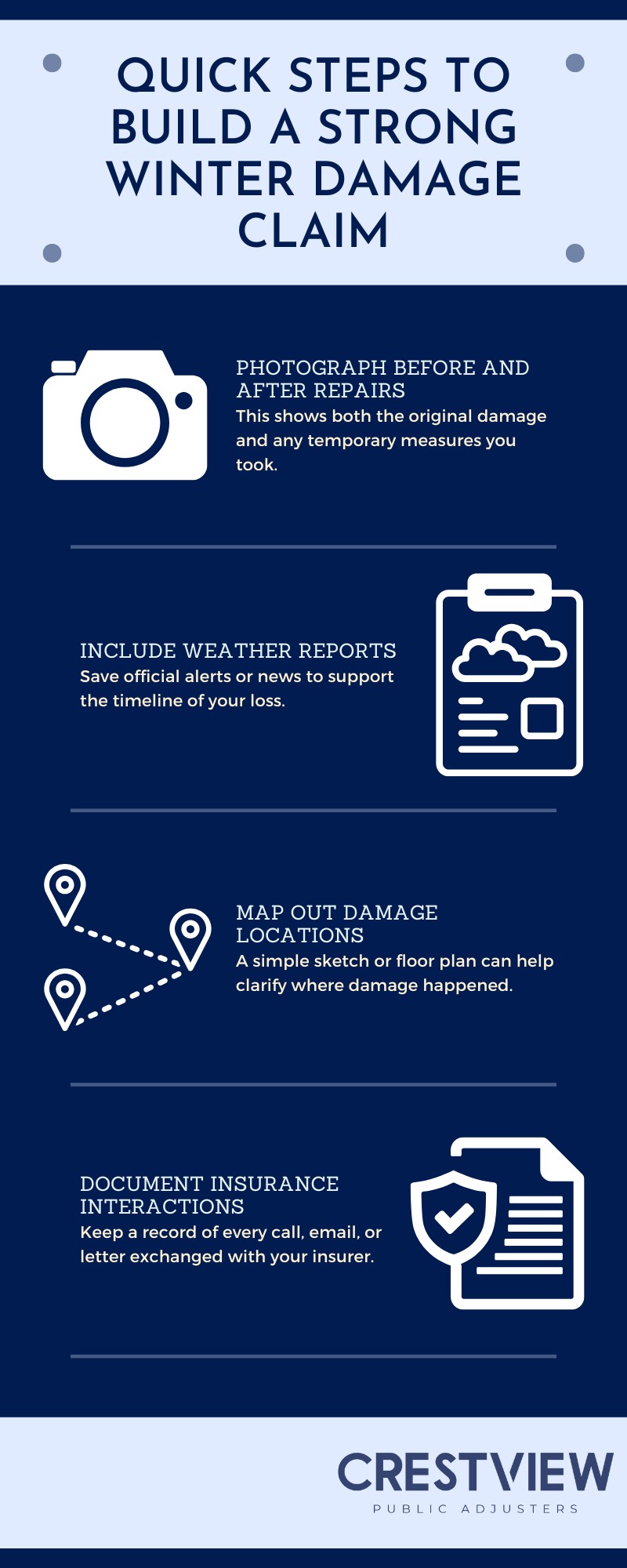
- Taking wide-angle photos of each damaged area, then zooming in for close-ups. Include time stamps when possible.
- Filming video walkthroughs of the property, narrating what you see, pointing out damage, and noting any safety hazards.
- Writing detailed notes describing the type and extent of damage. For example, note “broken window pane with glass scattered on floor” rather than “window damaged.”
Don’t forget to:
- Document all rooms, even those that appear unaffected.
- Record any damage to personal property, appliances, or furniture.
- Keep receipts for emergency repairs or temporary lodging if the home is uninhabitable.
Quick Steps to Strengthen Your Winter Storm Damage Claim
Strengthening your winter storm damage claim doesn’t have to feel overwhelming. By following a few quick, proactive steps, you can protect your rights and improve your chances of securing a fair settlement.
When Should You Start Documenting Winter Storm Damage?
You should start documenting damage immediately after it is safe to access your property. The sooner you begin, the stronger your claim will be because you can link damage directly to the storm event.
Insurance companies may argue that delays allowed additional, unrelated damage to occur. Timely documentation protects you against that. Additionally, early evidence can help you:
- Prioritize necessary repairs.
- Identify hidden damage early, such as leaks or structural shifting.
- Prevent disputes over the cause of damage.
If unsafe conditions (like downed power lines or ice hazards) delay your entry, make a note of the date and reason you couldn’t access the property right away.
How Can You Organize Your Documentation for the Insurance Claim?
Having evidence is one thing—organizing it in a way that supports your claim is another. Disorganized or incomplete files can lead to unnecessary complications.
Here’s how to stay organized:
- Create a folder (physical or digital) labeled by date and storm event.
- Separate evidence by type: photos, videos, written notes, receipts.
- Use a damage inventory checklist to ensure nothing is missed.
- Log communications with your insurance company and contractors (dates, names, summaries of discussions).
Clear organization allows your adjuster to review your claim faster, leading to quicker resolution.
What Types of Damage Should You Be Sure to Document?
Winter storms can cause a wide range of damage. It’s critical to capture all types—not just the obvious ones.
Make sure you document:
- Roof damage — missing shingles, ice dams, leaks, or punctures.
- Structural damage — cracks in walls or foundation shifts.
- Water damage — stained ceilings, warped floors, mold growth.
- Exterior damage — fallen trees, broken fences, damaged gutters.
- Interior damage — destroyed belongings, broken windows, damaged appliances.
- Utility disruptions — broken pipes, electrical damage, HVAC failure.
Small, overlooked details today could lead to big repair costs later.
Should You Hire a Public Adjuster for Winter Storm Damage Claims?
While it’s possible to handle a claim on your own, many policyholders choose to work with a public adjuster—especially for complex or large losses. Public adjusters represent you, not the insurance company, throughout the claims process. They ensure all damage is accounted for and valued fairly, and they negotiate directly with insurers to pursue a fair payout. This support can be particularly valuable if your documentation is incomplete or if the insurance company challenges parts of your claim.
Final Tips to Strengthen Your Winter Storm Damage Claim
Beyond gathering evidence, here’s how to build the strongest possible claim:
- Review your policy before filing. Know what’s covered and what isn’t.
- Report your claim promptly. Delays can raise red flags with insurers.
- Don’t discard damaged items until your adjuster has seen them or you’ve documented them thoroughly.
- Keep copies of everything. Don’t assume your insurance company will track it for you.
Staying proactive and detail-oriented, you protect your property and your finances.
Contact Crestview Public Adjusters for Winter Storm Claims
Protect your property and your peace of mind. Crestview Public Adjusters helps policyholders in New York, New Jersey, and Florida secure fair settlements for winter storm damage. Our team will review your documentation, handle negotiations, and ensure no detail is overlooked. Contact us today to get expert support for your winter damage claim.