
Key Points:
- Policyholders often face denied cyber claims due to misinterpretation of exclusions or failure to meet policy requirements.
- Inadequate documentation, delayed reporting, and non-compliance with cybersecurity protocols are common triggers for denials.
- Working with a public adjuster can help navigate complex policy terms and improve claim outcomes.
While cyber insurance is meant to be a safety net in today’s threat-heavy environment, the reality is that policyholders often face uphill battles during the claims process.
To help you stay informed and prepared, we break down the common reasons cyber claims are denied, including the nuances that lead to costly disputes with insurers.
What Are the Common Reasons Cyber Claims Are Denied?
Cyber insurance claims are commonly denied due to policy exclusions, late reporting, and failures in preventive cybersecurity practices. These denials often stem from misunderstandings of the policy’s fine print or lack of clarity on what is covered. It’s critical for policyholders to understand how insurers evaluate cyber claims to avoid costly mistakes.
Was Your Cyber Claim Denied Due to an Exclusion Clause?
Many policyholders only discover the limits of their cyber policy after filing a claim. Policy exclusions are among the leading causes of cyber claim denials—and they’re often buried in complex language.
Insurance companies use exclusions to define the boundaries of what they will and won’t cover. While this is a standard industry practice, it can leave you exposed if you assume all cyber incidents fall under your protection. Here are a few common exclusion-related reasons your claim may be rejected:
- War or State-Sponsored Attacks – If your data breach or ransomware attack is traced to a nation-state actor, many policies will deny the claim, citing an “act of war” exclusion.
- Prior Known Events – If the breach or vulnerability existed before the policy’s effective date, or if the organization was aware of the issue and failed to disclose it, this may be grounds for denial.
- Intentional Acts or Gross Negligence – Claims may be denied if your internal team was grossly negligent—such as disabling antivirus software or ignoring repeated security alerts.
Unfortunately, these clauses are rarely straightforward. That’s why reviewing your policy with a professional before and after incidents can drastically affect your outcome.
What Happens If You Report a Cyber Claim Late?
Timeliness is a key requirement in any insurance claim process, and cyber insurance is no exception. Most policies include strict “notification windows,” often as short as 24 to 72 hours after discovery of an incident. Miss that deadline, and your claim may be rejected outright.
- Why is timing so critical? – Because delays can impact an insurer’s ability to assess the extent and cause of the incident. If evidence has been tampered with, logs are missing, or third-party forensics haven’t been consulted, the insurer may argue that they can’t fairly validate your claim.
Common pitfalls that lead to late reporting include:
- Failing to recognize a cyberattack early
- Delays in internal escalation of security alerts
- Uncertainty about what qualifies as a “reportable event”
If your team isn’t trained on the exact reporting requirements of your policy, you may lose out on vital coverage simply due to procedure—not merit.

Is Poor Documentation a Valid Reason for Cyber Claim Denial?
Yes, and it happens far more often than it should. Documentation is everything when filing a cyber insurance claim. Without clear records, your insurer might argue that you failed to prove the scope or even existence of the cyber event.
Insurers commonly ask for:
- Incident logs
- Forensic reports
- Proof of data compromise or system breach
- Communication with affected customers
- Internal response timelines
If your IT department or cybersecurity team didn’t maintain proper logs or failed to preserve evidence during the incident response, insurers may view your claim as unverifiable.
To reduce this risk, implement a standardized documentation process across your organization. Be ready to back up every aspect of your incident response and recovery timeline with time-stamped proof.
Can Poor Cyber Hygiene Lead to a Denied Cyber Claim?
Absolutely. Many cyber insurance policies have “warranties” or requirements that your business must meet in terms of cybersecurity best practices. If you fail to uphold these, your claim can be invalidated.
Here are key examples where poor cyber hygiene can cost you:
- No Multi-Factor Authentication (MFA) – Many policies require MFA on email and critical systems. If a breach happens and you don’t have MFA enabled, expect scrutiny.
- Unpatched Software – Failing to update known vulnerabilities (such as not patching Log4j or similar exploits) can lead to claim rejections due to negligence.
- Weak or Reused Passwords – Insurers may deny claims stemming from credential stuffing or brute force attacks if your password protocols are subpar.
The lesson here? Your policy is not a get-out-of-jail-free card. It’s a partnership. You’re expected to maintain a baseline of security, and if you fall short, coverage may evaporate when you need it most.
What If the Cause of the Cyber Incident Isn’t Covered?
Cyber incidents can originate from many sources: phishing attacks, malware, insider threats, third-party vendors, and even physical theft of hardware. However, not all causes are covered equally.
For example, policies may exclude:
- Social engineering and phishing unless you’ve purchased optional endorsements.
- Insider threats like rogue employees unless specifically included.
- Third-party vendors’ negligence, especially if your contract doesn’t transfer liability appropriately.
If the root cause of the incident falls into a gray area, insurers may dispute coverage based on “unlisted perils” or misaligned definitions.
Before choosing cyber insurance, don’t just look at the premiums—dig into the trigger events, sub-limits, and endorsements. Otherwise, you might be left paying out-of-pocket despite thinking you were covered.
Can You Appeal a Denied Cyber Insurance Claim?
Yes, but it’s a process that requires strategic navigation. If your cyber insurance claim was denied and you believe it was wrongfully done, here are steps to consider:
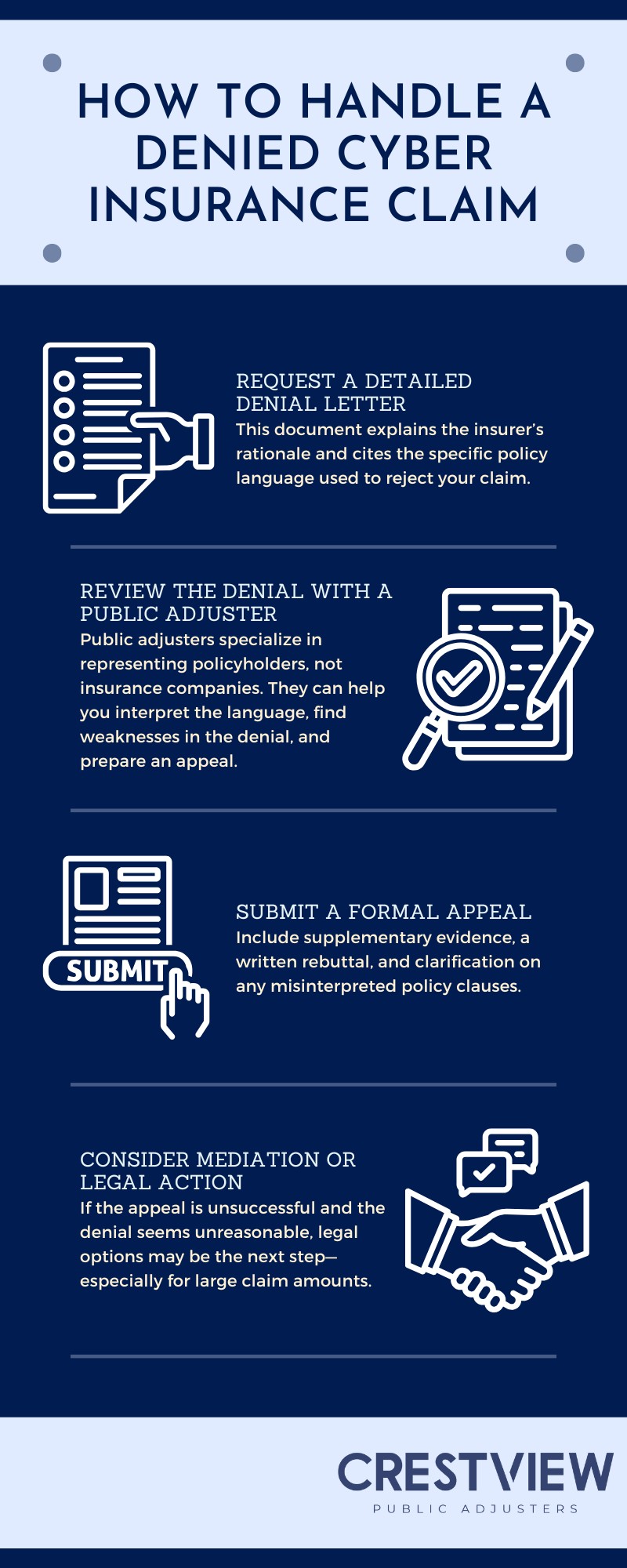
It’s important to note that once a claim is denied, you are working against the clock. Having professionals like public adjusters on your side can make a significant difference in reversing unfair decisions.
Secure Your Cyber Insurance Rights With Expert Help
Cyber insurance is a powerful tool, but only if you know how to use it—and defend it. Understanding the common reasons cyber claims are denied equips you to file stronger claims, avoid costly mistakes, and secure your business against one of today’s most unpredictable threats.
Protect Your Cyber Claim—Work With a Public Adjuster
Denied a cyber claim? Facing pushback from your insurer over coverage? Crestview Public Adjusters is here to represent your interests—not the insurance company’s. Our experienced team helps policyholders across Florida, New York, and New Jersey navigate complex cyber insurance policies, fight back against unfair denials, and recover what they’re rightfully owed.
Don’t let insurers dictate your outcome. Contact Crestview Public Adjusters today and protect your cyber claim.