
Key Points:
- Cyber claims involve complex processes that require detailed documentation, technical language, and strategic negotiation.
- Small businesses face unique challenges in cyber incidents, including limited resources and policy interpretation issues.
- Working with a public adjuster can level the playing field when negotiating with insurance carriers after a cyberattack.
Many small business owners are unprepared for the labyrinth of steps involved in filing a cyber insurance claim. Understanding how to navigate cyber claims for small businesses is no longer optional—it’s essential for business continuity and financial survival.
How to Navigate Cyber Claims for Small Businesses?
Navigating cyber claims for small businesses means understanding your policy, documenting damages thoroughly, and engaging experts to advocate for a fair settlement. Cyber insurance claims can be especially complicated due to technical forensics, coverage ambiguities, and insurer pushback.
To succeed, small business owners must treat cyber claims like business projects: time-sensitive, detail-oriented, and non-negotiable in terms of getting them right.
What Makes Cyber Claims So Difficult for Small Businesses?
Filing any insurance claim is challenging, but cyber claims introduce unique roadblocks that disproportionately affect smaller companies.
For one, cyber policies vary greatly in language and scope. Terms like “unauthorized access,” “data breach,” or “ransomware attack” may sound straightforward but carry precise definitions that can dramatically alter coverage outcomes.
Second, insurance companies often demand a high level of documentation—digital logs, forensics reports, incident timelines, and evidence of loss mitigation measures—none of which are easily accessible to the average small business.
Lastly, smaller firms often lack dedicated IT or legal teams. This leaves owners or general managers trying to interpret technical jargon and policy language under pressure—often while the business is still reeling from the disruption.
Here are some common barriers:
- Ambiguous Policy Language – Policies can exclude or limit coverage for third-party vendors, social engineering, or insider threats.
- Limited Internal Resources – Small businesses often lack incident response plans or dedicated cybersecurity staff.
- Delay Tactics from Insurers – Carriers may request repeated documentation or raise questions to delay or reduce payouts.
Understanding how to handle a cyber insurance claim starts with knowing these pitfalls.
What Should You Do Immediately After a Cyber Incident?
Responding swiftly and methodically is crucial after a cyber event. Delays or poor decisions in the first few hours can undermine both the recovery process and your insurance claim.
Here’s what to prioritize:
- Contain the Threat – Disconnect affected systems from the network. Engage an IT security professional to identify the scope and origin of the breach.
- Notify Stakeholders – Alert internal leadership, legal counsel, and your insurance provider. Prompt notice is often required for coverage eligibility.
- Document Everything – Start a timeline. Record what happened, when, and how you responded. Preserve logs and screenshots.
- Hire a Forensic Expert – Many cyber policies require a forensic analysis. Choose a vendor pre-approved by your insurer when possible.
- Review Policy Terms – Understand what your policy actually covers—business interruption, data recovery, notification costs, and more.
Taking the right actions early helps ensure your cyber insurance claim isn’t derailed by avoidable missteps.

What Information Do Insurers Require?
Insurance companies demand a large volume of supporting documentation for cyber claims. The depth and accuracy of this information often make or break a payout.
Here’s what most carriers will ask for:
- Incident Timeline: When did the breach occur? When was it discovered?
- Affected Systems/Data: Which files, applications, or data sets were impacted?
- Proof of Loss: Invoices, customer refunds, and business interruption calculations.
- Security Measures: Firewall logs, antivirus tools, encryption methods, and more.
- Communications: Emails with third-party vendors, legal notices, and customer disclosures.
The burden of proof is on the policyholder, not the insurer. That’s why understanding how to file a cyber insurance claim properly is so important.
How Can You Maximize a Cyber Claim Payout?
Even if you have solid coverage and documentation, the claim negotiation process can be difficult. Insurance companies scrutinize every detail, and small errors can result in partial or denied payments.
To improve your chances:
- Avoid Guesswork – Don’t make assumptions when filling out forms or describing the incident. Stick to facts and refer to expert reports when possible.
- Push Back Politely – If the insurer undervalues the claim, request clarification and provide supplemental evidence. Be prepared to negotiate.
- Track Communication – Keep a log of all phone calls, emails, and letters with your insurance provider.
- Request Advance Payments – For urgent expenses like system recovery or customer notifications, ask for partial payments upfront.
- Engage a Public Adjuster – Public adjusters can help quantify losses, prepare documentation, and negotiate for a fair settlement on your behalf.
Knowing how to manage cyber insurance claims is essential for protecting your company’s bottom line.
Can Cyber Claims Be Denied or Underpaid?
Yes—and they often are. Many small business owners assume that just because they have cyber insurance, they’ll be fully protected. In reality, insurers deny or underpay claims for several reasons:
- Late Notification: Failing to report the incident within required timeframes.
- Excluded Scenarios: Claims involving third-party vendors or phishing may be excluded.
- Inadequate Security: Some policies require proof of specific cybersecurity protocols (like MFA) to activate coverage.
- Ambiguous Documentation: Vague incident descriptions or incomplete financial loss calculations.
To avoid this, keep these tips in mind:
- Read Your Policy Carefully before you ever need to file a claim.
- Follow All Reporting Requirements exactly as written.
- Work with Experts to build a strong, defensible case.
Understanding how cyber insurance claims work empowers you to protect your business before, during, and after a digital crisis.
Why Are Public Adjusters Essential for Cyber Claims?
Public adjusters are licensed professionals who represent policyholders—not insurance companies. In cyber claims, their expertise can make a dramatic difference.
Here’s why:
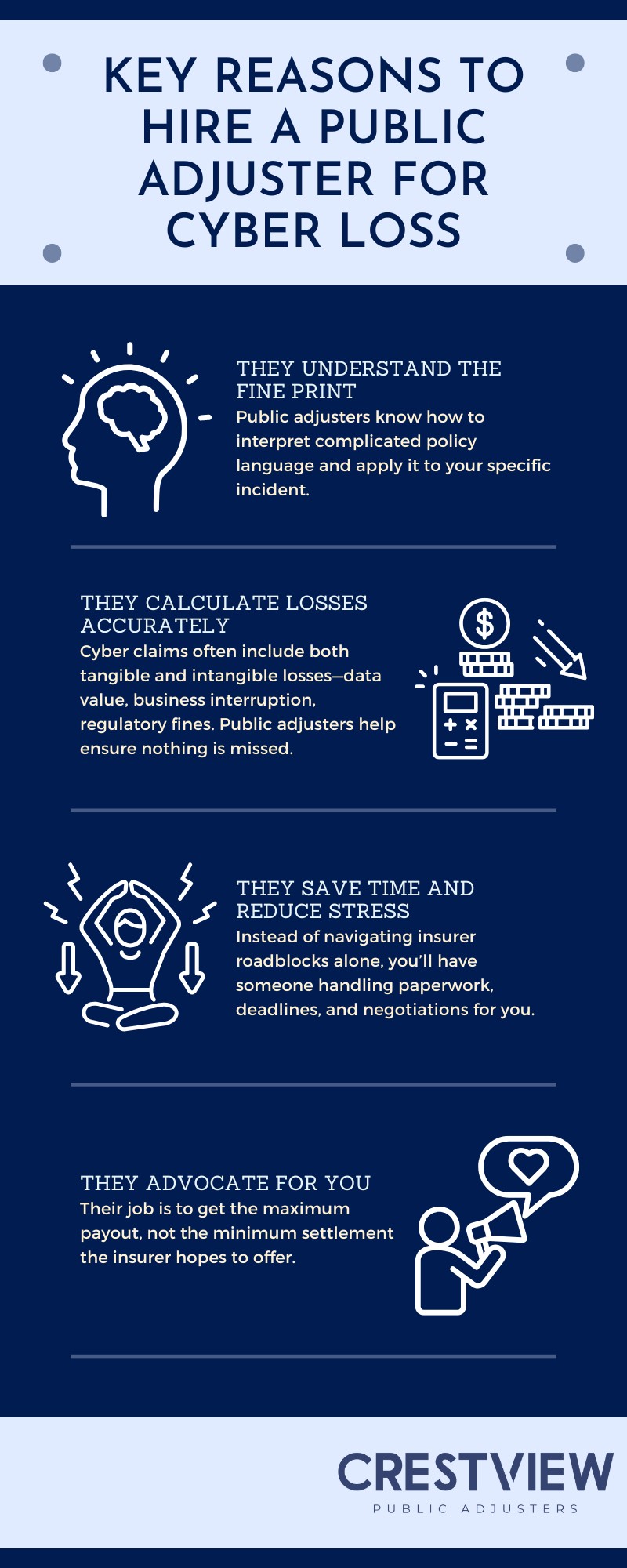
Especially for small businesses without internal legal or risk departments, a public adjuster acts as a much-needed ally.
Take Control of Your Cyber Claim
Cyberattacks can be devastating, especially for smaller operations. But by knowing how to navigate cyber claims for small businesses, you’re better equipped to respond quickly, file correctly, and recover fully.
You don’t need to tackle the claim process alone. Bringing in a professional advocate early can give you clarity, direction, and peace of mind.
Work with Crestview Public Adjusters Today
Maximize your cyber insurance claim—partner with experts who advocate for you. At Crestview Public Adjusters, we specialize in helping small businesses recover faster and smarter from cyber incidents. Whether you’re in Florida, New York, or New Jersey, we’ll work directly with your insurance carrier to fight for a fair payout. Our licensed adjusters understand the ins and outs of cyber policies and are ready to take the burden off your shoulders.
Contact Crestview Public Adjusters today to start your cyber claim journey with confidence.