
Key Points:
- Business interruption insurance doesn’t automatically pay out after a loss—it must be proven through accurate, well-supported documentation.
- Small business owners often make claim errors that delay or reduce their recovery.
- Working with a public adjuster helps navigate policy language and strengthens your claim with the right strategy and evidence.
According to the National Association of Insurance Commissioners, up to 40% of small businesses never reopen after experiencing a disaster. While some of these closures are due to physical destruction, many stem from the prolonged inability to generate income during recovery. Business interruption insurance exists to bridge that income gap—but filing and collecting on an interruption claim is rarely simple.
What Small Business Owners Should Know About Interruption Claims
Filing a business interruption claim involves proving your income loss, identifying policy triggers, and documenting your recovery timeline. It’s not just about having coverage—it’s about knowing how to use it.
What Does Business Interruption Insurance Actually Cover?
At its core, business interruption insurance replaces lost income when a business can’t operate due to a covered peril, such as fire, storm damage, or other events spelled out in your policy. It typically includes:
- Lost net income during the period of restoration
- Fixed operating expenses (like rent, payroll, and loan payments)
- Temporary relocation costs, if you move to continue operations
- Additional expenses needed to get your business running again
But coverage doesn’t mean automatic payout. Every claim must be backed by documentation, and each expense must be proven to be both necessary and within the scope of your policy. This is why What Small Business Owners Should Know About Interruption Claims is not just that coverage exists—but that proving a loss requires clarity and precision.
Why Do So Many Business Interruption Claims Get Denied?
It’s surprisingly common for claims to be delayed or denied, often due to preventable mistakes or a lack of documentation. Understanding the pitfalls can save your business months of frustration and potential financial loss.
Before diving into documentation tips, let’s look at some common reasons for denials:
- Insufficient proof of income loss
- Misinterpreting what is actually covered
- Failure to meet deadlines
- Missing the connection between the physical damage and business loss
To avoid these issues, small business owners need to prepare before disaster strikes and maintain clear records all year round.
What Should You Do Immediately After a Disruption?
Your actions in the first 48 hours after a loss can significantly impact your claim’s success. This isn’t just about securing the premises—it’s about protecting your financial future.
Here’s what you need to prioritize:
- Document the physical damage with photos and video
- Secure and preserve business records, especially income statements, payroll reports, and tax returns
- Notify your insurer promptly to avoid delays
- Track all expenses related to temporary fixes or relocations
- Record communication with vendors, landlords, and clients about interrupted operations
Doing these things early creates a reliable paper trail that supports your claim’s credibility.

How Can You Prove Lost Income?
You can’t just say, “We were closed, so we lost money.” You have to quantify the loss, and the insurer has to agree with your numbers. Here’s how you can do that:
- Show historical revenue trends from months or years prior to the event
- Use industry benchmarks to support your earnings projections if your business was newly established
- Present canceled orders, lost contracts, or refund records
- Keep clear financial reports showing fixed costs that continued despite the shutdown
Your claim becomes much stronger when it’s tied to evidence, not assumptions. This is a key piece of what small business owners should know about interruption claims—your proof must match your policy language.
What Is the “Period of Restoration” and Why Does It Matter?
Your insurance won’t cover lost income forever. The “period of restoration” is a defined time window, usually beginning when the physical damage occurs and ending when repairs should reasonably be completed.
Here’s what to understand about this period:
- It’s not necessarily the time it actually takes to rebuild—if delays are caused by poor planning or permit issues, coverage might end before you reopen.
- It doesn’t begin until physical damage occurs. If your operations shut down for precautionary reasons, you might not be covered at all.
- Some policies include extended coverage (e.g., 30 or 60 days beyond reopening) to help you regain customer flow.
It’s vital to review the definition of your policy’s restoration period so that your expectations (and timelines) match your coverage.
What’s the Role of Civil Authority Coverage?
If government action forces your business to close—even if your property isn’t damaged—you might still qualify for business interruption compensation under civil authority coverage.
This part of your policy could apply if:
- A government agency denies access to your premises
- There’s a direct connection between nearby damage and your closure
- The policy includes a trigger timeframe (often 72 hours)
However, civil authority coverage usually has a time limit, and documentation is again critical—especially proving the closure was a direct result of external orders.
How Can a Public Adjuster Help?
Understanding what small business owners should know about interruption claims means recognizing when to bring in professionals who can advocate for their best interests. A public adjuster works for you—not the insurance company—and plays a crucial role in managing the claims process. They interpret complex policy language to uncover any hidden benefits, accurately calculate and justify your losses, and organize a complete, defensible claim. Most importantly, they negotiate on your behalf to help maximize your financial recovery. Insurance companies have professionals protecting their side—so it only makes sense that you have someone equally qualified representing yours.
What Are Some Examples of Recoverable and Non-Recoverable Costs?
A business interruption claim can cover a wide range of losses—but it won’t cover everything. Misunderstanding what qualifies can lead to costly surprises.
Here’s a breakdown:
Typically Covered:
- Lost net profits
- Mortgage or rent payments
- Employee wages
- Relocation or setup costs for a temporary location
Not Usually Covered:
- Utilities during closure unless needed for mitigation
- Undocumented losses or speculative projections
- Losses from uninsured events (e.g., flooding without flood insurance)
Always compare your policy’s inclusions and exclusions carefully.
How Long Does It Take to Settle a Business Interruption Claim?
Timeframes can vary significantly depending on claim complexity, documentation quality, and insurer responsiveness. That said, here’s a rough breakdown of a typical timeline:
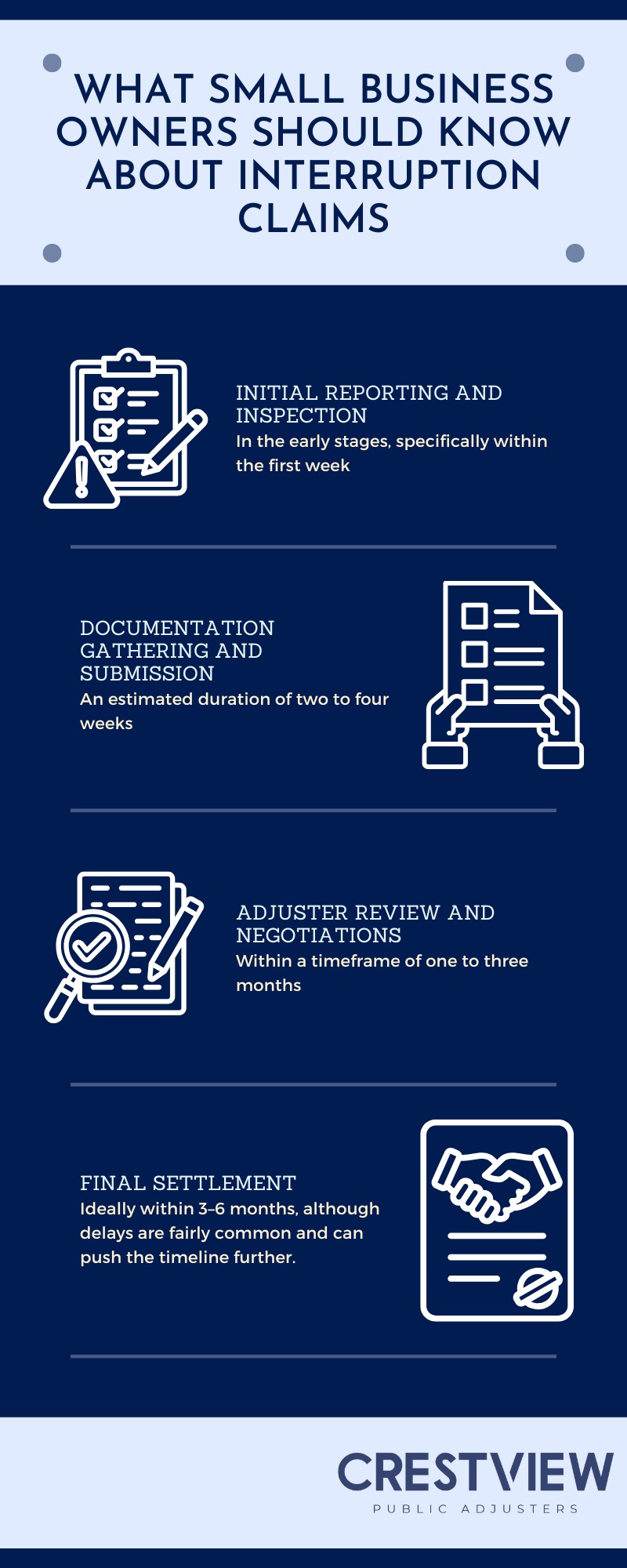
If your documentation is weak or the insurer disputes your calculations, the process can stretch far longer. That’s why many business owners work with public adjusters to speed up results and avoid unnecessary friction.
Call on Expert Support for a Smoother Claim Process
Navigating a business interruption claim is one of the most technical and time-sensitive challenges a small business owner can face. One wrong move can delay your payout—or reduce it dramatically. That’s where Crestview Public Adjusters comes in.
We help business owners across New Jersey, Florida, and New York with detailed claim preparation, policy interpretation, and insurer negotiations. Whether you’re dealing with physical loss or civil authority shutdown, our team works directly with you to build and defend a strong claim from day one.
Contact Crestview Public Adjusters today and protect the business you’ve worked so hard to build.