
Key Points:
- Business interruption coverage depends on the type of natural disaster and the specific policy language.
- Not all events—like floods or earthquakes—are automatically included.
- Documentation, timing, and the cause of interruption play a major role in whether claims are approved or denied.
In 2023 alone, the U.S. faced 28 separate billion-dollar weather and climate disasters, totaling over $92.9 billion in damages, according to NOAA. For businesses, the destruction doesn’t end when the storm passes. Often, the bigger financial blow comes later—when operations grind to a halt and revenue vanishes. Business interruption insurance exists to soften that blow—but only if you understand what’s actually covered.
What Does Natural Disasters and Business Interruption: What’s Covered? Actually Mean?
The phrase “Natural Disasters and Business Interruption: What’s Covered?” refers to what specific types of damage or disruption qualify for reimbursement under a business interruption insurance policy. These typically include income loss due to property damage caused by covered natural events—but not all disasters are treated equally.
What Triggers Business Interruption Coverage?
Most business interruption coverage kicks in only when there’s direct physical damage to the insured property caused by a covered peril. That means it’s not just about the storm or quake—it’s about how it impacts your specific building or equipment.
Before your claim is even considered, three conditions typically must be met:
- A covered cause of loss must occur (e.g., fire, hurricane, windstorm).
- There must be direct physical damage to insured property.
- The damage must cause a necessary suspension of business operations.
The “covered cause” part is where many policyholders get tripped up. For example, wind and fire are commonly included. Floods and earthquakes? Not so much—they often require separate policies or endorsements.
What Natural Disasters Are Typically Covered?
Natural disasters vary in how insurers handle them. Some are standard in most commercial property policies, while others are excluded unless explicitly added. Here’s how different types are typically treated:
Often Covered (Depending on Policy)
- Hurricanes
- Tornadoes
- Wildfires
- Windstorms
- Blizzards or Snowstorms
Typically Excluded (Unless You Have a Rider)
- Flooding
- Earthquakes
- Mudslides or Sinkholes
- Tsunamis
- Volcanic Eruptions
Make sure to check your policy’s “Covered Perils” section and any named storm or flood exclusions that could bar your claim from being paid out.

Does Civil Authority Coverage Apply?
Sometimes, your building isn’t damaged—but you’re forced to shut down due to government orders. That’s where Civil Authority coverage comes in. It can kick in when a government-mandated restriction prevents access to your premises after a nearby disaster.
To qualify:
- The order must stem from damage to a nearby property (not yours).
- The damage must be from a covered peril.
- The order must be official and documented.
This coverage is often time-limited—commonly up to 30 days—but it’s crucial for situations like evacuation zones after a wildfire or mandatory closures during a hurricane aftermath.
How Long Does Business Interruption Coverage Last?
The coverage period—known as the “period of restoration”—starts after a brief waiting period (typically 72 hours) and lasts until:
- The property is repaired or replaced,
- Operations resume at a new location, or
- The policy’s time limit is reached.
Coverage doesn’t continue indefinitely. Insurers expect reasonable progress in repairs, and delays due to inaction may shorten the benefits window. This means documentation, project timelines, and even contractor availability can affect how much you ultimately recover.
What’s Usually Included in Business Interruption Coverage?
Business interruption policies typically reimburse the following expenses—provided they directly relate to the covered event and the loss of income.
Covered Items Often Include:
- Net income lost due to halted operations
- Fixed operating expenses (like rent and utilities)
- Payroll costs to retain employees
- Relocation costs, if you need to temporarily move operations
- Loan payments or taxes due during the outage
- Extra expenses, such as equipment rentals to keep some operations running
What’s Not Covered Under Business Interruption Insurance?
Even if your policy covers certain natural disasters, there are common exclusions that could still limit your claim. These often include income loss that isn’t directly tied to physical damage, delays caused by zoning or permitting issues, and power outages that aren’t the result of a covered peril.
Additionally, losses stemming from communicable diseases or pandemic-related restrictions are typically excluded, as is income loss that occurs after the official restoration period ends. Undocumented revenue projections or inconsistent bookkeeping can also jeopardize your claim. Insurers will closely scrutinize your financial records, which is why having clean, consistent documentation is absolutely critical.
How Can You Maximize a Business Interruption Claim?
Even if you meet all the policy conditions, you still need to prove the financial impact of the disruption. That means keeping detailed records and being proactive about documentation.
Here’s what you should do:
- Document all damage with photos, videos, and repair estimates.
- Track lost income by comparing it with the same period in previous years.
- Retain all receipts for expenses related to recovery or temporary operations.
- Review your policy language—look for exclusions, endorsements, or coinsurance clauses.
- Work with a professional public adjuster to calculate and present your claim effectively.
Being underprepared or submitting vague data is one of the biggest reasons claims are underpaid or denied.
How Do Insurance Companies Handle These Claims?
Adjusters from the insurance company work for the insurer—not for you. Their goal is to limit the company’s financial exposure, not to ensure you receive a full recovery. When handling business interruption claims, insurers typically inspect the damaged property and compare it to the terms of your policy.
They request financial records, such as profit-and-loss statements, to calculate the value of your claim. It’s not uncommon for them to argue that the loss is overstated or that portions of it are unrelated to the disaster. Throughout the process, they often demand continuous documentation as repairs move forward. This is exactly why having an independent public adjuster on your side can help level the playing field.
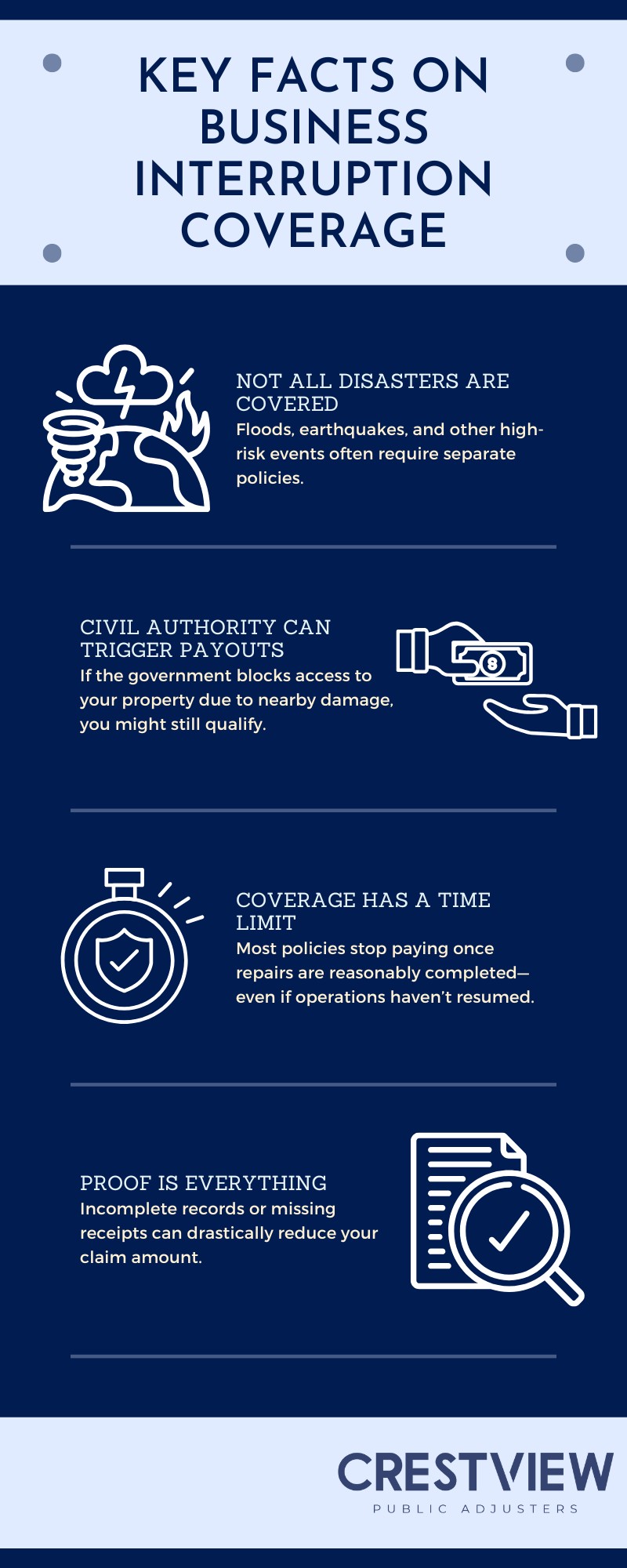
Quick Facts About Business Interruption Insurance Coverage
Business interruption insurance helps cover lost income and operating expenses when your business is forced to close due to a covered event—like a fire, natural disaster, or other unexpected disruption.
Final Thoughts on Natural Disasters and Business Interruption: What’s Covered?
Understanding what’s covered when a natural disaster disrupts your business isn’t just about reading the headline of your policy—it’s about digging deep into the definitions, exclusions, and conditions. Business owners often assume they’re covered for events like floods or government-mandated closures, only to discover otherwise when it’s too late.
To protect your livelihood, make sure you:
- Review your current policy regularly.
- Understand which perils are included—and which are not.
- Prepare your financial records for claim readiness.
If you’re ever unsure about the language in your policy or how a recent storm impacts your eligibility, get advice before you file. That clarity could mean the difference between a successful recovery and a denied claim.
Get Help From Expert Public Adjusters Today
If you’re dealing with the aftermath of a natural disaster or trying to make sense of your business interruption insurance policy, Crestview Public Adjusters is here to help. Our team specializes in Business Interruption Claims, offering thorough assessments, accurate documentation, and policyholder-first negotiation strategies.
Whether you’re located in Florida, New York, or New Jersey, we’ll work to ensure you receive every dollar you’re entitled to under your policy.
Contact Crestview Public Adjusters today—let us handle the insurance headaches so you can focus on getting your business back on track.