
Key Points:
- Ensure your frozen pipes insurance claim is honored by acting fast, documenting thoroughly, and proving you limited damage.
- Photograph damage before cleanup, save receipts, and get a dated plumber’s note confirming freeze-related failure.
- Organize files with photos, estimates, and moisture logs to move claims quickly and avoid denial.
Ice expands. When pipes freeze and burst, damage can spread fast. You’ll want to move quickly, support your frozen pipes insurance claim with solid proof, and show you acted responsibly. Insurers look for thorough documentation and timely action.
This guide shows how to document, report, and manage the claim so your home insurance frozen pipes claim holds up.
Understand When Frozen Pipes Are Covered
First, know what your policy says. Many homeowners insurance policies include frozen pipes insurance coverage. That means if a pipe freezes and bursts, resulting water damage can be covered. But only if certain conditions are met.
National loss data shows winter weather remains a recurring driver of property losses across the U.S., with 27 billion-dollar disasters recorded in 2024.
Homeowners ask the same core question: does insurance cover frozen pipes? Coverage often excludes long-term leaks, wear and tear, and neglect. That means your actions before, during, and after the freeze affect frozen pipes insurance coverage as much as the break itself.
Adjusters look for a clear timeline, visible origin, and steps you took to limit damage. When a winter surge strains capacity, organized files move faster.
Use this coverage checklist to set expectations:
- Cause ties to a freeze with a defined date and area, not gradual seepage.
- Damage results from sudden discharge, not long-term deterioration or prior mold.
- Duties after loss show you reduced harm: shut water, protected rooms, and began dry-out.
Take First-Day Actions That Protect Your Claim
Frozen pipe claims move faster when the first 24 hours create a clear chain of evidence. The strongest files open with clean photos before cleanup, a dated plumber’s note confirming the break, and early moisture readings that justify removal of wet materials.
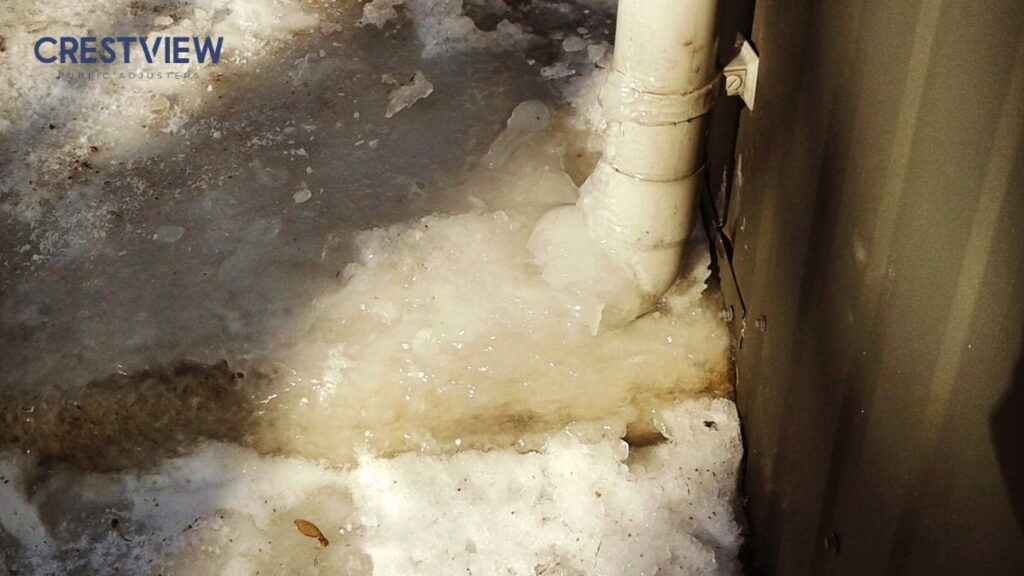
Physical science explains why speed matters. Ice expansion strains pipe walls and joints; water volume increases by about 9% when it freezes, which helps explain why splits appear as lines thaw.
Prioritize these first-day steps:
- Stabilize and document winter storm damage. Photograph every room from multiple angles, then add close-ups of the break, shutoff, and visible damage.
- Capture the cause. Ask the plumber for a brief note listing the date, location, and “freeze-related failure,” plus photos of the opened section.
- Start mitigation. Begin extraction and drying; save daily humidity and moisture logs. Keep removed materials until the adjuster confirms the scope.
Build Documentation That Persuades the Adjuster
Once you spot a frozen pipe or damage, document water damage. Time matters. Immediate action supports a strong home insurance frozen pipes claim.
Insurers ask the same sequence of questions: What failed? When did it fail? What did you do to prevent further damage? Answer those clearly, and the “home insurance frozen pipes claim” moves with less friction
For Additional Living Expenses (ALE), save hotel, meal, and laundry receipts. Present a short timeline in the front of the file so the adjuster sees fast action and clear prevention steps, and include a complete proof of loss.
Assemble a convincing claim package:
- Cause and origin file: Plumber’s note, cut-out section photos, and a simple diagram of the line that failed
- Dry-out file: Extraction invoice, daily psychrometric logs, equipment placement photos, and moisture maps
- Room-by-room file: Before-and-after photos, material removal notes, and contractor estimates that match what was opened.
Align Scope and Pricing to Real Conditions
Frozen pipe claims succeed when the scope mirrors what your home actually needed. Push for a line-item estimate that follows the path of water and the places crews opened.
Pricing starts with quantities. Linear feet of baseboard, square feet of drywall, and board-feet of framing drive totals. Unit costs come from a pricing database or contractor bids. Overhead and profit (O&P) may apply when multiple trades coordinate work.
Keep the scope tight and defensible:
- Mirror the moisture map. If readings show a wet band, the cut line follows that band and not just a round number.
- Tie every line to a photo. Place the photo index on page one so an adjuster sees evidence before price.
- Explain choices. Note why materials cannot be cleaned in place, why cabinets cannot be saved, or why flooring cannot be patched.
Communicate With the Insurer Without Losing Ground
Frozen pipes homeowners insurance claims move through stages. Each stage benefits from steady communication and clean files.
Timing expectations vary by state and by surge conditions. One practical anchor is claim frequency itself; water damage and freezing drive a predictable share of homeowners’ losses nationwide. According to data, about one in 60 insured homes files a property damage claim for water damage or freezing in a typical year.
Keep the claim on track:
- Consolidate updates into a weekly packet with invoices, photos, and notes.
- Request written rationales when items are denied or reduced; respond with evidence tied to your scope.
- Track payments against line items and keep a ledger that shows prior payments and outstanding items.
Avoid Avoidable Denials and Reductions
Report the loss early, then follow with details. Start mitigation as soon as the area is safe. Keep “chain of custody” on damaged materials until the adjuster verifies scope.
Homes with prior water issues require extra care. If a previous leak existed, separate that area with photos and dates. If the frozen line ran through a previously repaired zone, call that out and show why the current damage is new.
Reduce denial risk with disciplined proof:
- Show “sudden and accidental.” Anchor cause in a dated plumber’s note and photos of the opened section.
- Show mitigation. Provide dry-out readings, equipment logs, and material removal notes that align with standards.
- Show necessity. Connect every replacement to a condition that cannot be restored by cleaning.

Frequently Asked Questions
Is frozen pipe damage covered by insurance?
Yes, frozen pipe damage is usually covered by homeowners insurance when water damage is sudden and accidental. Coverage may be denied if the home was not heated or if neglect caused the loss. Renters policies cover personal belongings, while structural repairs fall under the landlord’s insurance.
Who is responsible for frozen pipes?
Homeowners are responsible for frozen pipes on their property after the meter, while utilities handle mains and the meter. Landlords must maintain plumbing and provide habitable rentals, but tenants may be liable if negligence or lease violations, such as failing to keep heat on, cause freezing. Local codes apply.
How can you prove water damage?
Prove water damage by photographing and filming the affected areas before cleanup, listing damaged property, and saving receipts for repairs and mitigation. Keep contractor reports, estimates, and all communications. Report the source accurately, such as a burst pipe, since mislabeling as flood damage may void coverage.
Get help documenting and negotiating your claim
Claiming coverage for frozen pipes doesn’t have to feel confusing. At Crestview Public Adjusters, we make the process clear and fair. Our public claims management services in New York, Florida, and New Jersey help homeowners through every step of a frozen pipes homeowners insurance claim.
We gather proof, organize documentation, and negotiate so your insurer honors valid claims. You gain support with inspections, proof-of-loss, and tracking damage. We bring experience and persistence, so your case gets the attention it deserves.
Reach out today for a free consultation. Let’s help make sure your frozen pipes insurance claim gets treated properly.