
Key Points:
- Recoverable depreciation is released after you finish repairs and submit a complete holdback packet with invoices, photos, receipts, and permits.
- Timelines vary by state, and mortgage lenders may control disbursement.
- To get paid fast, match your documents to the insurer’s estimate, follow lender steps, and escalate delays through appraisal or mediation.
Storm damage hits cash flow when the insurer pays ACV first and parks the rest as a holdback. Recoverable depreciation is the amount withheld and released after you show proof of repair or replacement under your home insurance policy.
Up next, you’ll see how to trigger the release, which timelines apply in Florida, New York, and New Jersey, and when to use appraisal or mediation before litigation.

What Is Recoverable Depreciation in an Insurance Claim?
Recoverable depreciation is the difference between replacement cost and actual cash value (ACV), held until you complete repairs or replace items. Policies with replacement cost add back depreciation once you submit proof; ACV-only policies do not.
Consumer regulators explain that insurers usually pay ACV first, then reimburse the recoverable depreciation after receipts show the work was done, which is standard across home insurance claims.
Why it exists
- Cash control: Insurers prevent overpayment if you don’t complete the work.
- Verification: Receipts validate scope and price before the holdback is released.
- Policy terms: RCV endorsements outline deadlines and proof of loss requirements.
Real-world pressure
Homeowners face slower cycles and tighter scrutiny. Satisfaction drops sharply as claim cycle time stretches; one national study shows scores near 903 when settled in under three weeks but down to 727 after 31+ days.
When Should You Invoke Recoverable Depreciation?
Invoke recoverable depreciation once the covered work is finished and you can document it. Waiting rarely helps, because state clocks and lender requirements can slow disbursement. Home insurance recoverable depreciation unlocks faster when you anticipate what the carrier, contractor, and mortgagee will ask for.
Timing drivers
- Proof timing: Many carriers require invoices and proof of completion before cutting the holdback check.
- Mortgage clause: If a lender is listed, the check can require lender endorsement or be routed through loss-draft control, which often ties to the commercial or residential claim process the servicer follows. Servicing guides show lenders may be a named payee and must endorse or manage release.
- State prompts: Regulators expect prompt investigation and clear updates; your submission date starts or affects those clocks.
A major consumer study reported 5.3% of insured homes filed a claim in 2023, so carriers process large volumes with strict rules. Clean, early documentation helps you avoid the slow lane.
What Documents Trigger the Holdback Release?
Strong files get recoverable depreciation paid faster. Build a clean packet and submit in one transmission when possible.
Core proof
- Final contractor invoice: Shows scope completed and balance due/paid. Many carriers require this before releasing the holdback.
- Proof of payment or completion: Paid receipts, lien waivers, or a completion certificate where it was used.
- Photo evidence: Before/after photos tied to line items in the estimate.
- Permit/inspection sign-offs: If local code required permits, attach approvals.
- Supplement approvals: Any insurer-approved changes or code upgrades.
- Mortgagee endorsement (if listed): Follow lender loss-draft instructions; checks may require lender signature.
Quick note: Questions on how insurance companies calculate depreciation on a roof come up often, and public adjuster guidance for roof claims explains the age, condition, and useful-life factors. Regulators note that depreciation considers age, condition, useful life, and current cost; RCV restores full replacement cost after proof.
What Are the Timelines to Watch (FL, NY, NJ)?
State rules won’t guarantee same-day payment, but claim timelines shape expectations you can cite in emails and escalation requests.
Florida (Residential property, including reopened/supplemental)
- Acknowledge claim communications within 7 days.
- Begin investigation within 7 days after receiving proof-of-loss; inspect within 30 days of that proof.
- Pay or deny all or part of the claim within 60 days after notice of claim, with interest if late; clocks can toll during mediation or appraisal.
New York (Regulation 64)
- Acknowledge notice of claim within 15 business days.
- After a properly executed proof-of-loss, advise acceptance or rejection within 15 business days or explain why more time is needed and update every 90 days if still investigating.
New Jersey
- Commence investigation within 10 working days; acknowledgment and forms also have 10-day standards.
Your recoverable depreciation packet, including the final invoice, receipts, and photos, gives the carrier what it needs to move from “investigation” to “payment.” If timelines slip after you submit, cite the rules above when requesting status.

Appraisal or Mediation: Which Speeds Up a Holdback When You’re Underpaid?
Underpayment can delay the holdback because the carrier disputes price and scope. Appraisal and mediation often resolve valuation faster than a lawsuit.
Appraisal (amount-of-loss only)
- Carrier vs. insured appraisers: Each side picks an appraiser; they work to agree on the amount of loss, a path often used after an underpaid fire claim or similar scope dispute.
- Umpire: If they disagree, differences go to a jointly chosen umpire; if any two of the three agree, the award binds the parties on value.
- Costs: Each party pays its appraiser; parties split the umpire fee.
Mediation (Florida DFS program)
- Neutral meeting: You, the insurer, and a DFS-approved mediator meet to try to settle.
- Eligibility: Claim becomes eligible after the insurer complies with payment/denial duties or triggers other steps; the 60-day pay/deny clock can be tolled during mediation.
- Access: DFS explains how to schedule and prepare; it’s designed to be quick and inexpensive.
Appraisal focuses on numbers, not coverage legalities, and often delivers a faster, recoverable depreciation release once the award sets the final amount. Mediation adds a facilitated negotiation without court delays.
Recent reporting based on regulatory data shows a large share of homeowners’ claims close without payment; for example, about 42% nationally in 2024, with some states higher, so structured dispute options matter.

Step-by-Step: How to Get Your Holdback Paid Fast
1) Build the file before work finishes
- Scope alignment: Match contractor scope to the carrier estimate or approved supplement.
- Photo log: Capture each trade completion and serial number for big items (roofing, HVAC).
- Permit close-outs: Pull final inspections early to avoid lender delays.
2) Submit a complete holdback packet
- Cover note: List invoices, receipts, photos, permits, and lien waivers.
- Proof of completion: Attach a brief statement from the contractor with dates.
- Payment proof: Bank image, canceled check, or paid-in-full invoice.
3) Loop in the mortgagee if named
- Endorsement path: Ask for loss-draft instructions and timelines; some servicers must be a payee and control disbursement.
4) Track state timelines and follow up
- Florida: Reference the 7-day acknowledgment and 60-day pay/deny window.
- New York: Reference 15-day proof-of-loss response and 90-day status letters.
- New Jersey: Reference 10-day investigation start.
5) Escalate the right way
- Mediation: Fast, low-cost scheduling through DFS in Florida.
- Appraisal: Use when the dispute is price/scope; expect to pay your appraiser and half the umpire.
6) Keep an eye on cycle time
Long cycles erode outcomes and patience. National research connects slower claims with sharply lower satisfaction scores, which is a strong reason to push for timely review of your recoverable depreciation packet.
Who Gets the Recoverable Depreciation Check?
Many carriers send the recoverable depreciation check to the insured, but it can also name the contractor or mortgagee depending on policy language and lender requirements. Consumer resources and lender guides confirm that loss-draft control can require lender endorsement before funds are released.
Tip: If a lender is on the draft, ask for its inspection or draw a schedule early to prevent a funding gap midway through repairs.
How Does Insurance Roof Depreciation Work?
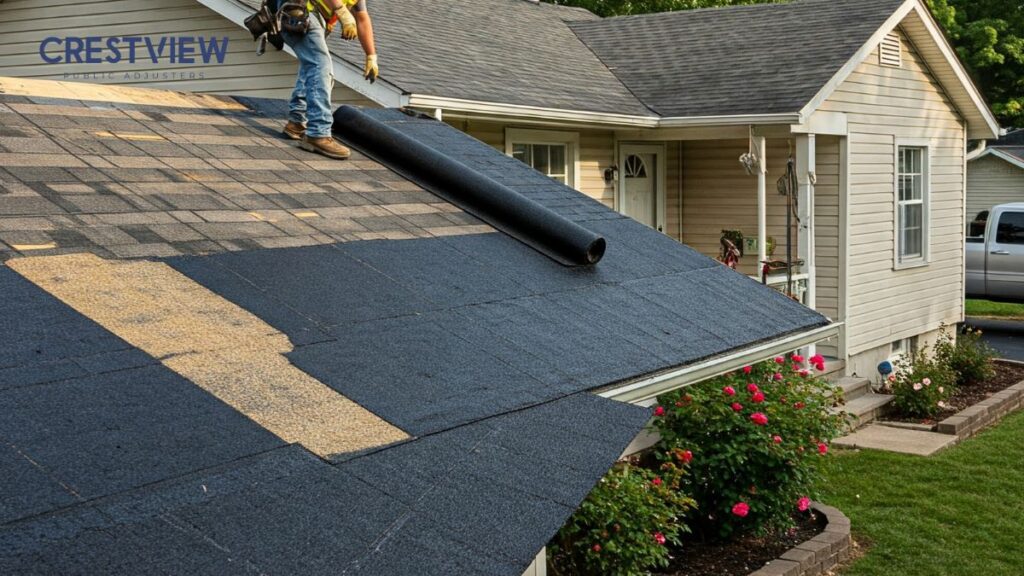
Roof depreciation reflects age, expected life, condition, and replacement cost. With RCV, the carrier pays ACV first, then recoverable depreciation after you prove replacement. With ACV coverage, the depreciation stays deducted. Regulators outline these basics to help set expectations for roof claims.
Roof packet add-ons
- Contractor’s final invoice with squares and materials.
- Shingle manufacturer and permit sign-offs.
- Photos of tear-off, underlayment, flashing, and finished roof.
Outcomes vs. Litigation: What Should You Expect?
Litigation takes time and adds legal costs. Appraisal and mediation tend to resolve valuation and payment flow sooner, especially when coverage is accepted and the dispute is numbers-only.
Pros before court
- Speed: Appraisal awards and DFS mediation sessions often land faster than court dockets.
- Focus: Amount-of-loss only in appraisal reduces scope bloat.
- Clock control: Florida’s timelines and tolling rules help keep pressure on progress.
High non-payment closure rates reported by multiple outlets make structured, file-ready negotiation essential to recover recoverable depreciation without a drawn-out lawsuit.
Frequently Asked Questions
Do I get to keep the recoverable depreciation?
You receive recoverable depreciation only after repairs are complete and documented. It covers the gap between actual cash value and replacement cost, not extra profit. If repairs cost less, the insurer pays the lower amount. Mortgage lenders may control the funds, requiring endorsements or draw approvals.
What is an example of recoverable depreciation?
An example of recoverable depreciation is a $20,000 roof replacement with $6,000 depreciation and a $2,000 deductible. The insurer pays $12,000 actual cash value (ACV) upfront. After you complete the work and submit proof, the insurer pays the $6,000 recoverable depreciation, totaling $18,000. You pay the $2,000 deductible.
How do I get back a recoverable depreciation check from insurance?
Get back a recoverable depreciation check by completing the repairs and submitting a holdback packet with the final invoice, photos, receipts, and permits. If a lender is listed, follow their endorsement or inspection process. If delays occur, cite state timelines and request mediation or appraisal if needed.
Start Your Holdback Release
Working with experienced help can shorten the path from ACV to full replacement cost. Public insurance adjusting and claims management in Florida, New York, and New Jersey can organize proof-of-loss, frame supplements, and steer appraisal or mediation when underpayment blocks recoverable depreciation.
At Crestview Public Adjusters, we focus on clear documentation and timely escalation so your holdback funds follow the work, not the other way around. Ready to move your holdback? Contact us to review your estimate, build the release packet, and, if needed, launch an appraisal or schedule mediation to resolve unpaid amounts.