Key Points:
- Insurance companies may underpay fire damage claims due to undervaluation, policy misinterpretation, or lack of documentation.
- Policyholders can dispute underpaid claims through negotiation, appraisal, or legal action.
- Public adjusters offer expertise in maximizing settlement amounts and navigating insurer tactics.
According to the National Fire Protection Association (NFPA), U.S. fire departments responded to an estimated 1.35 million fires in a single year, resulting in $15.9 billion in property damage. Despite this, thousands of homeowners and business owners find themselves grappling with underpaid fire damage claims, leaving them unable to fully restore their properties or recover financially.
What to Do If Your Fire Damage Claim Is Underpaid
If your fire damage claim is underpaid, you don’t have to accept the insurance company’s initial offer. You can dispute it by reviewing your policy, gathering evidence, and hiring a public adjuster or pursuing legal recourse. Insurers often underpay to protect their bottom line—but you have options.
Why Do Insurance Companies Underpay Fire Damage Claims?
Insurance companies operate as for-profit businesses. While they’re contractually obligated to cover your loss, their goal is to minimize payouts.
Several common reasons your fire claim may be underpaid:
- Undervaluation of damage: Insurers might overlook smoke damage, structural weakening, or personal property loss.
- Improper use of depreciation: They may depreciate items more than they should, reducing your payout.
- Ambiguous policy language: Vague terms may be used to deny full coverage.
- Inadequate inspection: Some companies rely on third-party contractors who may miss or downplay damage.
- Lack of documentation: Insurers may claim insufficient proof for certain losses.
These tactics can leave you footing the bill for repairs you thought were covered. Understanding these patterns is the first step toward successfully disputing an underpaid claim.
How to Recognize an Underpaid Fire Damage Claim
It’s not always obvious that your claim was underpaid. Insurance adjusters may offer a settlement that seems fair—until the repair bills start rolling in.
Warning signs your claim might be underpaid:
- The offer doesn’t cover full repair costs.
- Damages like smoke, soot, or water damage aren’t fully accounted for.
- Personal belongings were undervalued or excluded.
- You were pressured to settle quickly.
- The claim payment is significantly lower than estimates from licensed contractors.
If any of these apply, you likely received less than what your policy entitles you to. Don’t cash that check until you’ve done your homework.
What Steps Should You Take if Your Claim is Underpaid?
If you suspect or confirm underpayment, don’t panic—but act strategically. Here’s how to respond:
Review your insurance policy thoroughly – Understand what your policy actually covers. Pay close attention to exclusions, deductibles, and limits. You may find that the insurer’s payout doesn’t reflect your actual coverage.
Request a detailed breakdown of the payment – Ask the insurer to itemize their calculations. Knowing what they covered (and what they didn’t) gives you leverage when disputing the claim.
Gather additional documentation – Secure photos, videos, repair estimates, and inventory lists. Independent estimates from contractors can be especially powerful.
Get a second opinion – Hire a licensed public adjuster. These professionals represent your interests, not the insurer’s, and often uncover missed or undervalued items.
File a formal dispute – Write to your insurance company with a detailed explanation of why you believe the payment is inaccurate. Include supporting documents.
Invoke the appraisal clause (if available) – Many policies allow you to initiate a formal appraisal process if you disagree with the settlement.
Seek legal assistance – If all else fails, hiring an attorney with insurance claim experience may be necessary—especially for large losses or bad faith behavior.
Should You Accept a Low Settlement Offer?
Never accept a claim settlement unless you’re absolutely sure it’s fair. Once you accept and deposit the check, you might waive your right to dispute it later.
Insurers may use urgency or emotional exhaustion to push you into accepting less than you deserve. It’s vital to give yourself time, gather all documentation, and explore your rights.
In many cases, rejecting an initial lowball offer can lead to a significantly higher payout after further negotiation or formal dispute.
What Are Your Legal Rights as a Policyholder?
Every insurance policy is a binding contract. As a policyholder, you have specific rights—some of which are protected by state law.
Legal protections you may have include:
- The right to a fair claims process
- The right to receive your claim decision within a reasonable timeframe
- The right to dispute low or denied claims
- The right to hire a public adjuster or attorney
In some states, insurers can face penalties for “bad faith” handling of claims—such as delays, unfair denials, or misrepresentation of policy terms.
Understanding your rights empowers you to challenge unfair outcomes without fear.
Can a Public Adjuster Help With an Underpaid Fire Damage Claim?
Yes. Public adjusters work exclusively for policyholders—not insurance companies. Their goal is to ensure you receive the full payout you’re entitled to under your policy.
They assess the damage independently, prepare the claim properly, and handle communication with the insurer. Many policyholders see claim increases of 30–70% after hiring a public adjuster.
Here’s how they help:
- Provide accurate damage assessments
- Document and inventory all property losses
- Negotiate with the insurance company on your behalf
- Prevent unnecessary delays and denials
- Maximize the final settlement amount
Hiring a public adjuster often levels the playing field, especially when the claim involves extensive or complex fire damage.
How Long Do You Have to Dispute an Underpaid Fire Insurance Claim?
Your insurance policy may have shorter timeframes for certain processes, like invoking an appraisal clause or submitting supplemental documentation.
Waiting too long could mean forfeiting your right to challenge the decision. Act promptly.
Common deadlines to watch for:
- Deadline to file an appeal or supplement
- Deadline to invoke appraisal
- Statutory deadline to file a lawsuit
Always check both your policy and state-specific laws. When in doubt, consult a public adjuster or insurance attorney to protect your rights.
How to Respond When Your Fire Damage Claim Is Underpaid
Knowing the right steps can make all the difference when facing an underpaid fire damage claim. Here are four crucial actions to take immediately:
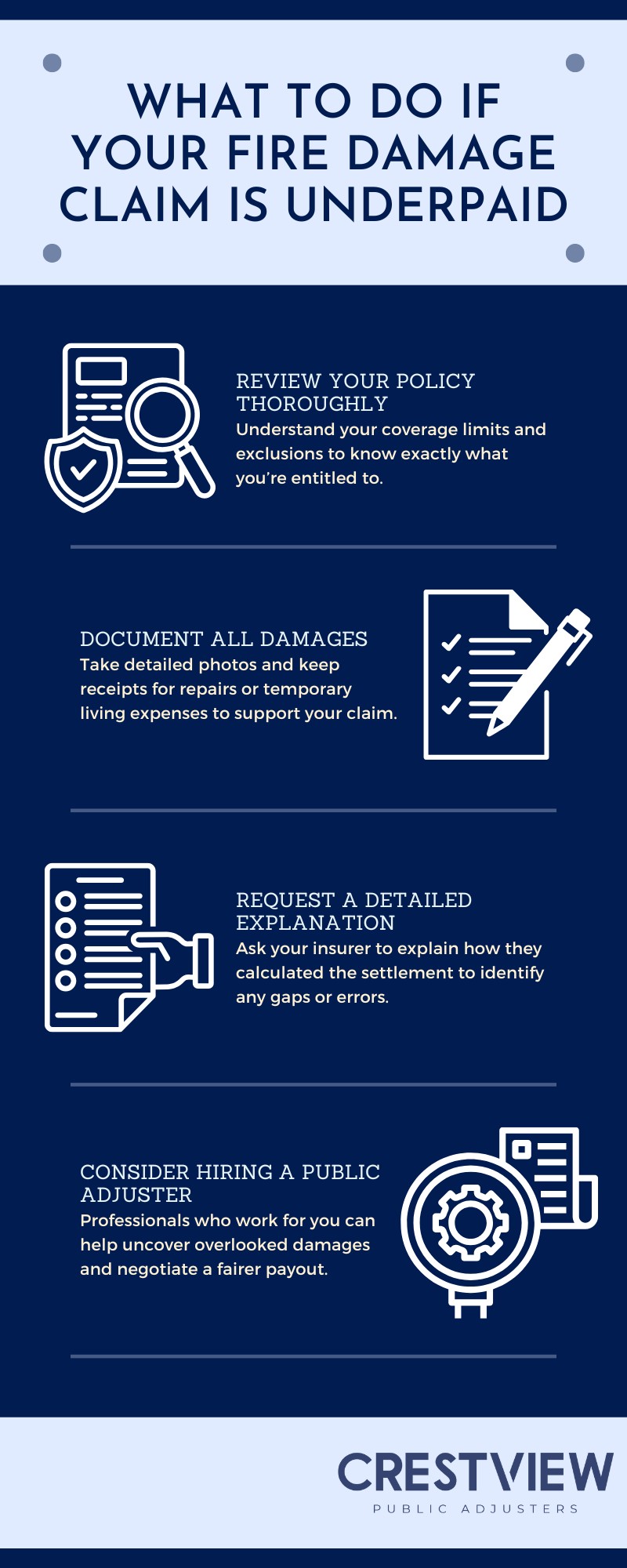
These steps can help you build a stronger case to challenge an insufficient settlement and get your claim back on track.
What Happens if You Already Accepted the Check?
If you’ve already accepted and deposited the insurer’s check, your options may be more limited—but not necessarily gone.
Some insurance companies include a release clause with the check, which waives your right to pursue additional payment. However, if no such clause was signed or included, you might still be able to reopen the claim.
Even if the claim appears closed:
- You can file a supplemental claim if new damage is discovered
- You may challenge improper depreciation or overlooked losses
- You can request a reinspection by a third-party expert
The key is not to assume it’s over until you’ve consulted a professional.
Maximize Your Fire Damage Claim Payout With Expert Help
The claim process can be overwhelming—especially after a devastating fire. And if you’re facing an underpaid fire insurance claim, navigating it alone might cost you thousands.
Working with professionals who understand fire damage, policy language, and insurer tactics can make all the difference. You paid premiums for peace of mind—don’t let your insurer shortchange you when it matters most.
Get the Settlement You Deserve – Contact Crestview Public Adjusters Today
If you’re located in New Jersey, Florida, or New York and dealing with the frustration of an underpaid fire damage claim, don’t let the insurance company dictate your recovery. At Crestview Public Adjusters, we work exclusively for policyholders—never insurers. Our experienced team understands the complexities of fire damage and knows how to uncover what’s often overlooked or undervalued.
Whether you’ve received a low settlement or feel your claim wasn’t handled fairly, we’re here to help you take control of the process. From independent inspections to policy interpretation and negotiation, we advocate on your behalf every step of the way.
Reach out to Crestview Public Adjusters today and let us fight for the full compensation you deserve.