
Key Points:
- An AC unit water damage claim may cover resulting damage to ceilings, walls, floors, insulation, and belongings when the water release meets policy terms.
- Coverage often depends on whether the leak was sudden or gradual.
- Photos, technician reports, moisture readings, maintenance records, and drying logs support the timeline.
An AC unit water damage claim may cover resulting damage to ceilings, walls, flooring, insulation, and covered belongings when the water release fits the policy’s covered-cause language. For New York policyholders, coverage depends on the policy form, exclusions, and evidence showing whether the overflow happened suddenly or developed over time.
At Crestview Public Adjusters, we review the source report, moisture trail, maintenance history, and policy wording so owners can see which parts of the loss need further support.
What an AC Unit Water Damage Claim May Cover in New York
An AC unit water damage claim involves two distinct parts: the equipment that failed and the property damaged by the escaping water.
The New York State Department of Financial Services clarifies how policy forms treat water releases from cooling systems.
- A Broad Form policy generally covers accidental water discharge or overflow from an air-conditioning unit as a named peril.
- A Special Form policy covers direct physical loss to the building unless the policy specifically excludes that cause.
- Condo, co-op, commercial, and landlord forms divide building elements and personal items differently. Water damage coverage limits, endorsements, and deductibles also affect your final payout structure.
When owners ask, “Does insurance cover AC leaks?” the answer turns on whether the policy handles equipment breakdown or resulting damage. Your HVAC water damage coverage usually applies to building materials soaked by the overflow rather than replacing the old AC unit itself.
| Coverage category | Items to discuss | Policy question |
|---|---|---|
| Resulting damage that may qualify | Drywall, ceilings, insulation, flooring, built-in finishes, covered contents, and drying work | Did covered water damage follow a covered event? |
| Source repairs treated separately | Worn drain pan, blocked line, failed pump, damaged float switch, or aging component | Does the policy cover equipment breakdown or only resulting damage? |
| Damage likely facing closer review | Repeated seepage, corrosion, old staining, mold, delayed reporting, or prior leaks | Does the evidence show one event or an ongoing condition? |
Why Fall Discovery Changes the Evidence, Not the Policy
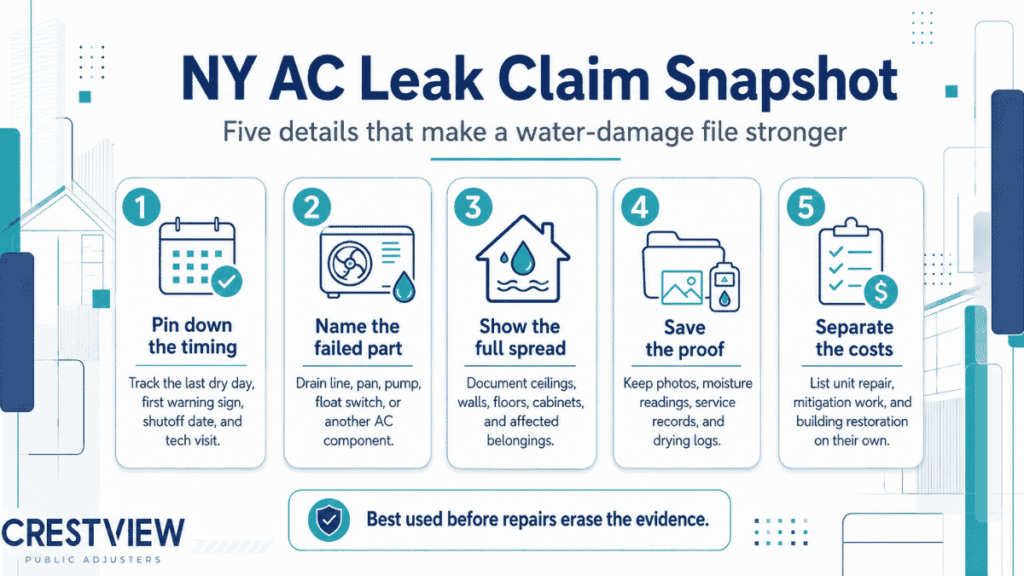
Discovering a stain in October does not automatically prove when the leak began. To build an accurate HVAC leak insurance claim, we assemble a four-date timeline:
- The last date the area appeared dry.
- The first date staining, moisture, or odor appeared.
- The date your AC system shut off for the season.
- The date an HVAC technician identified the leak source.
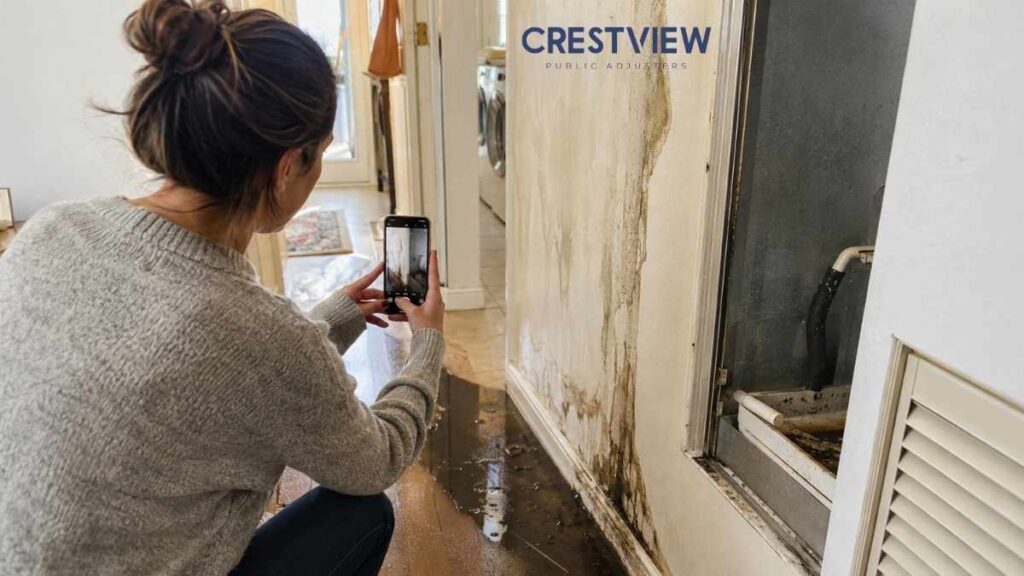
Stain size or discoloration alone cannot confirm when water escaped. Technician notes, moisture readings, service records, and clear photographs establish a complete picture.
For example, a mechanical closet in a Manhattan condo creates a tight water route into adjacent units. An attic air handler in a suburban house near Albany, Rochester, Syracuse, or Buffalo might drip through ceiling joists before showing upstairs. In both setups, connecting system operation to the affected building materials keeps the claim moving.
How New York Policies Separate Sudden Overflow From Ongoing Seepage
How an AC Unit Water Damage Claim Gets Tested Against the Timeline
A single fall discovery date does not answer whether water escaped during one sudden overflow or through repeated condensation. Insurers look closely at timing, maintenance, and system logs before approving a condensation claim or issuing a water damage claim denial.
| Claim question | Useful evidence |
|---|---|
| Which component failed? | HVAC report naming the pan, line, pump, connection, coil, or shutoff device |
| Did water release at once? | Technician opinion, photographs, dated video, system records, and witness accounts |
| How far did water travel? | Moisture mapping, room-by-room photographs, ceiling openings, and drying logs |
| Was the condition recurring? | Prior service invoices, earlier stains, repair requests, and maintenance records |
| Did the owner act after discovery? | Shutdown records, mitigation invoices, emails, and inspection scheduling |
Fall discovery does not prove gradual damage on its own. However, an incomplete technician note like “clogged drain” can trigger a denial if it omits the underlying cause, safety switch status, or sudden nature of the backup.
An unclear HVAC report can create a coverage dispute before the full repair scope is known. Crestview Public Adjusters can review your policy, technician findings, and documented water trail. Contact our team for a New York AC-related water-damage claim review.
Which Parts of Air Conditioner Water Damage Belong in the Claim File
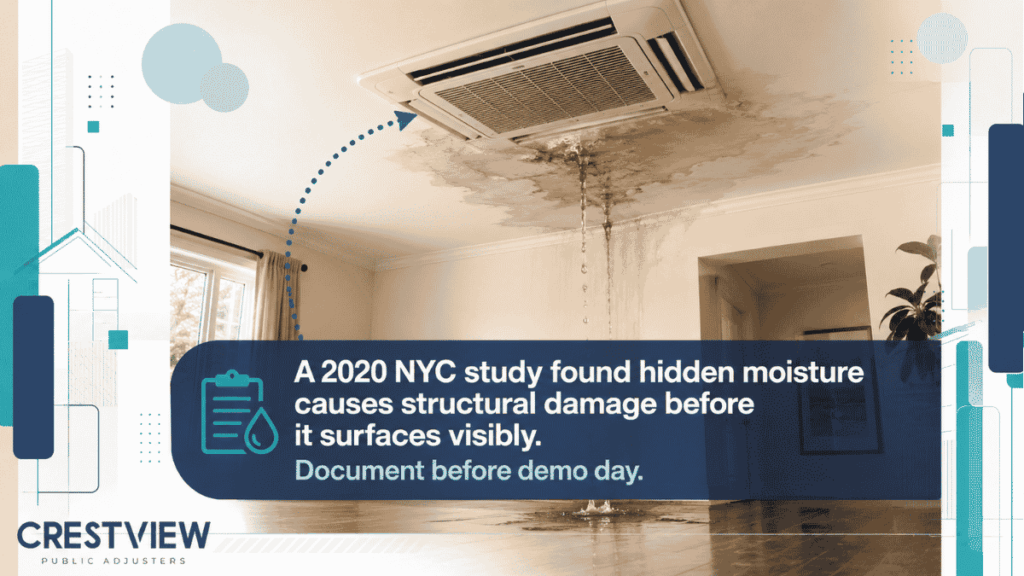
Every air conditioner water damage file requires a clear itemization of affected property. Visible surface stains rarely tell the whole story. A 2020 study of New York City homes showed strong links between hidden moisture accumulation and structural material deterioration.
To capture the complete loss, we separate your records into three categories:
- The HVAC technician invoice covering the failed equipment.
- The water mitigation logs covering emergency extraction and structural drying.
- The construction scope covering physical building repairs.
Your claim file should track specific building elements damaged by water:
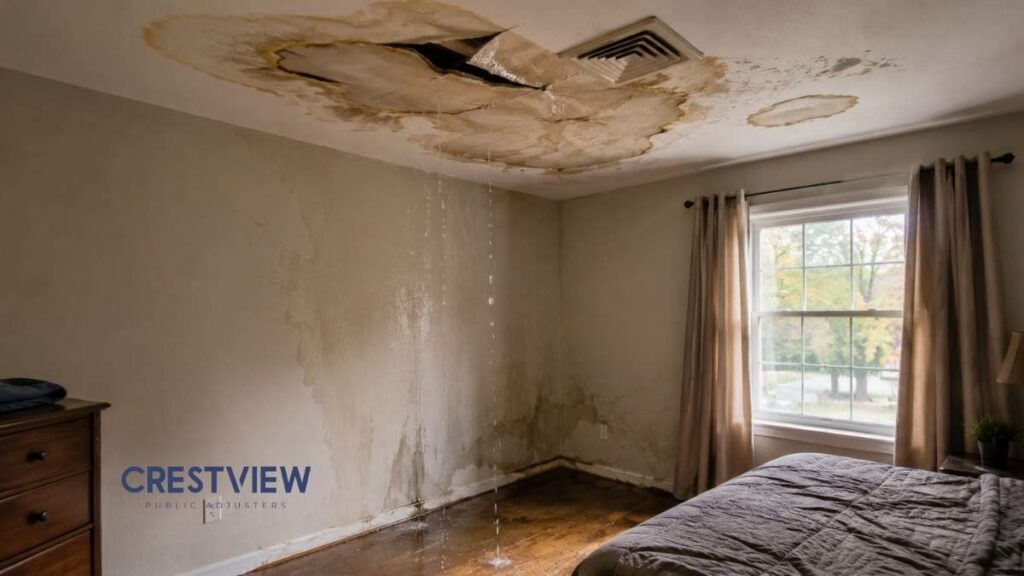
- Ceiling drywall, plaster, and framing cavities.
- Wall insulation, baseboards, and subflooring.
- Hardwood, tile, or carpeted flooring.
- Custom cabinetry, trim, and built-in woodwork.
- Electrical fixtures or wiring exposed to moisture.
- Personal property, furniture, and personal belongings.
In New York City condos and co-ops, management access logs and building records must also line up with these repair categories.
What New York Owners Should Document Before Repairs Move Ahead
Before contractors tear out drywall or throw away damaged materials, assemble these records to protect your AC overflow insurance claim:
- Wide and close photos of all damage before demolition starts.
- Pictures of the drain pan, line, pump, float switch, and standing water.
- Retained physical parts or clear photos of failed components before disposal.
- A detailed HVAC technician report stating the exact failure mechanism.
- A room-by-room moisture map from your drying company.
- Past annual service invoices and routine maintenance logs.
- Written communications with your condo board, landlord, or property manager.
- Daily drying logs and professional mitigation invoices.
Ask your HVAC technician for factual observations rather than insurance opinions. A useful report describes the part that broke, the observed condition, the repair completed, and whether prior leaks existed.
A recurring file problem for our team is an invoice that only says “cleared drain” after the failed parts have been discarded. The record then shows the repair took place but leaves the original cause and condition unanswered, increasing the risk of an underpaid insurance claim. Having these details organized early keeps your AC unit water damage claim supported from day one.
FAQs About an AC Unit Water Damage Claim
Does a New York condo or co-op owner file under the unit policy or the building policy?
The unit policy addresses interior finishes and personal property, while the master policy covers common elements. Bylaws, proprietary leases, and equipment ownership dictate responsibility. We often request both policies early so coverage overlaps do not delay your repair review.
Can a home warranty and homeowners policy both apply to the same AC leak?
A home warranty may cover repairing the broken AC component itself. Homeowners insurance reviews resulting physical damage to ceilings or floors. Each contract has separate deductibles and rules, so approval under one contract does not guarantee coverage under the other.
Can emergency drying begin before the insurance inspection?
Emergency drying should start immediately to prevent secondary damage. Photos, moisture readings, drying logs, and saved physical parts protect your water-loss file and any related mold damage claim. During one recent inspection, having pre-mitigation moisture logs prevented the carrier from claiming the drying work was unnecessary.
Review Your New York AC Leak Before the File Loses Detail
Fall discovery places your failure timeline and moisture records at the center of the coverage review. Clear technician notes, retained parts, and complete drying logs make a significant difference when distinguishing a sudden overflow from ongoing seepage.
At Crestview Public Adjusters, we review AC-related water claims for homeowners, condo boards, landlords, property owners, and business owners across New York, including New York City, Buffalo, Rochester, Syracuse, Albany, the Capital District, and nearby communities.
Call (551) 316-7204 or send your claim details. Our team will review your policy, discovery date, technician report, and physical damage to confirm your file has the right support.