
Key Points:
- Incomplete documentation and vague loss narratives are major reasons business interruption claims get delayed or denied.
- Misinterpreting policy language often leads to disputes with insurers and unsuccessful claims.
- Working with a public adjuster early can prevent costly mistakes and improve your claim’s chances of approval.
According to a report by the National Association of Insurance Commissioners (NAIC), up to 40% of small businesses fail to reopen after suffering a disaster, with many citing denied or delayed insurance claims as a core reason. Business interruption (BI) insurance is supposed to offer a lifeline during these periods, but too often, claims don’t go as planned. And in most cases, it isn’t just the insurer at fault—claimant errors are frequently to blame.
Let’s break down the common mistakes that delay or deny business interruption claims, how they happen, and what you can do to avoid them.
Common Mistakes That Delay or Deny Business Interruption Claims
Filing mistakes, documentation gaps, and misreading your policy are some of the most frequent causes of a delayed or denied business interruption claim. These preventable errors can set your recovery back by months—or even lead to a full denial.
Understanding why claims get delayed or denied helps you take control early. Below are the most common reasons business owners fail to get paid out on their BI policies—and how to avoid them.
Failing to Understand Policy Language and Triggers
One of the biggest pitfalls policyholders face is not fully understanding what their business interruption policy actually covers.
At its core, BI insurance only kicks in after a covered loss causes direct physical damage that halts operations. But that’s just the starting point. Many policies have nuanced wording that limits or expands this coverage.
For example:
- Some policies require that a civil authority order completely prohibit access to your premises.
- Others define “restoration period” differently, affecting how long you can claim lost income.
- Some policies exclude certain events altogether (e.g., utility failures unless originating on the property).
Failing to grasp these distinctions can lead business owners to file claims that were never valid to begin with—or to miss providing the right evidence to show their loss falls under a covered event.
Here’s where it goes wrong:
- Misreading exclusions or limitations
- Not knowing that dependent properties (suppliers/customers) must be named for coverage
- Assuming partial interruptions are always covered
To avoid this mistake:
- Review your policy in detail with a licensed professional.
- Ask about common BI exclusions and how your restoration period is calculated.
- Ensure you understand what evidence you’ll need if an event occurs.
Insufficient Financial Documentation
Many policyholders underestimate just how much financial data they need to back up a business interruption claim.
Insurers won’t just take your word for lost profits—they want proof. If you can’t demonstrate your historical revenue patterns and how the interruption caused a measurable dip, your claim will stall.
You’ll typically need to submit:
- Profit and loss statements (pre- and post-loss)
- Sales forecasts and budgets
- Tax returns
- Payroll records
- Inventory reports
Common documentation errors include:
- Submitting incomplete records
- Failing to isolate loss-specific periods
- Using inflated or speculative projections
The solution? Maintain meticulous financial records and work with a professional (such as a CPA or public adjuster) to tie your numbers directly to the loss event. Forecasts must be realistic and rooted in historical trends.

Delaying the Filing Process
Timeliness is everything. Delaying your business interruption claim—or failing to notify your insurer promptly—can seriously harm your chances.
Reasons delays cause trouble:
- Insurers question the severity of your loss if you took too long to report.
- Time-sensitive inspections may no longer be possible.
- Your policy may include strict deadlines for claim reporting (e.g., 30-60 days).
Some business owners wait because they’re unsure whether the event qualifies, or they want to handle repairs first. But this hesitation can backfire.
To stay on track:
- Notify your carrier immediately after the interruption.
- Keep detailed records of all repairs and expenses as they occur.
- Document conversations with your insurer and follow up in writing.
Not Calculating Extra Expenses Correctly
Many BI policies include an “extra expense” clause, covering costs that go beyond normal operations but help minimize the interruption.
This could include:
- Renting temporary space
- Buying backup equipment
- Paying overtime to staff
Where claimants go wrong:
- Not tracking these expenses clearly
- Not understanding which costs qualify
- Failing to link expenses to minimizing the loss
Each extra expense must be justified as a cost that reduced your business loss or helped you get back up and running sooner.
Be sure to:
- Save receipts and contracts
- Keep a detailed log of how each expense impacted operations
- Consult your adjuster about which costs are worth including
Assuming Partial Losses Are Fully Covered
Many business owners think that any slow-down in operations due to a covered event equals a valid claim. Not quite.
Policies often require a complete cessation of operations, or a material loss in revenue tied directly to physical damage. If you’ve only experienced a dip in productivity or partial disruption, your claim must prove that this directly stems from the covered loss.
Mistakes related to partial losses:
- Overestimating impact on sales
- Not comparing with pre-loss trends
- Failing to separate BI loss from market downturns
Avoid overgeneralizing. Make your loss measurable and specific. Include evidence like:
- Before-and-after sales charts
- Customer cancellations tied to the event
- Logs of equipment downtime
Lack of a Coherent Narrative
Your claim needs more than just data—it needs a story that connects all the pieces. Insurance companies assess:
- What happened?
- How did it impact your business?
- How does the policy respond?
If your documentation is disjointed or lacks a clear through-line, adjusters may question its legitimacy.
Ways to fix this:
- Create a timeline of events
- Include photos, receipts, and logs in a sequential format
- Write a clear narrative connecting damage to financial loss
Public adjusters often help here, using their experience to craft a compelling claim package that makes sense to insurance carriers.
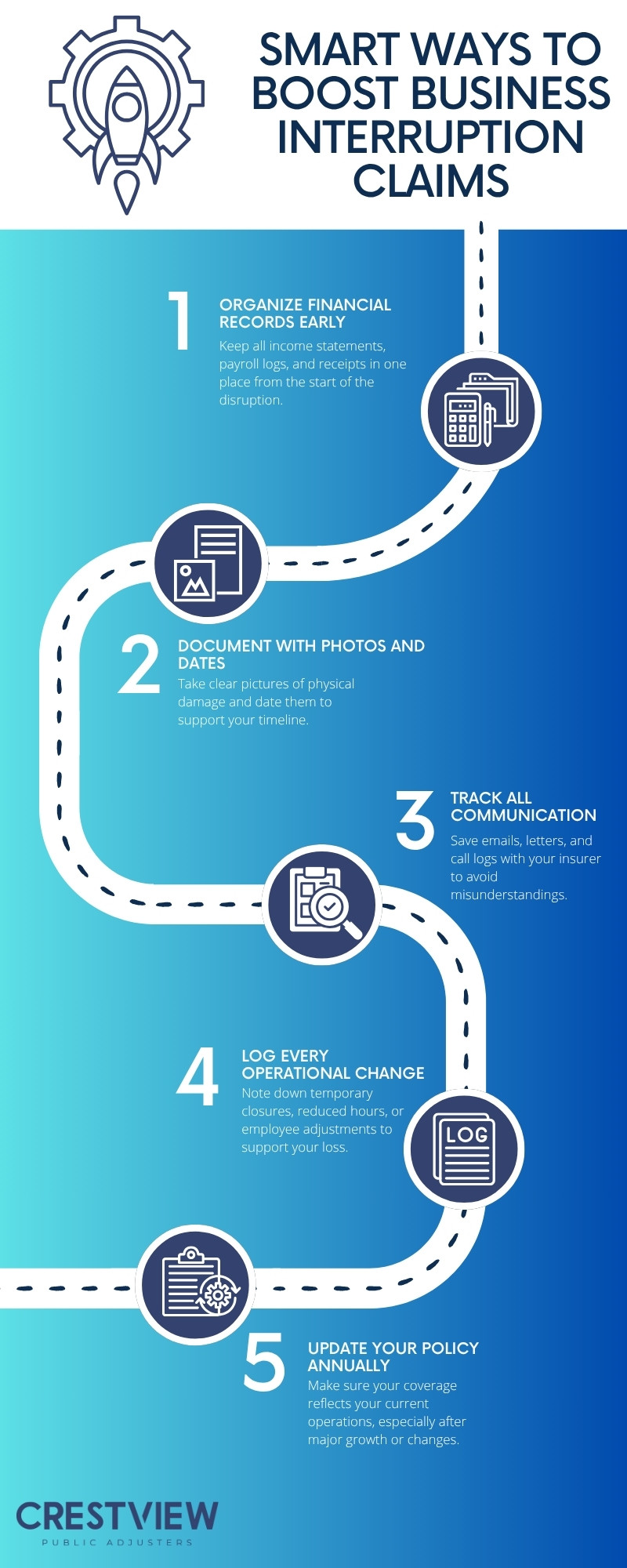
Quick Tips to Strengthen Your Business Interruption Claim
Even small improvements in how you prepare your claim can make a big difference. Here are some quick, practical steps you can take right now:
Not Consulting a Public Adjuster Early On
Even the most organized policyholder can make mistakes—especially when navigating the complexities of business interruption claims. These claims are notoriously tricky, and insurers often make the process harder than it needs to be. That’s where public adjusters come in. Unlike insurance company representatives, public adjusters advocate solely for you. They help interpret dense policy language, prepare and submit accurate claims, and negotiate to ensure you receive the maximum possible recovery.
Going it alone often leads to costly errors. Many policyholders unintentionally leave money on the table by overlooking covered losses or misclassifying damages and lost income. Others get stuck when insurers delay, unsure of how to escalate the claim properly. While it’s possible to bring in a public adjuster after issues arise, partnering with one from the start greatly reduces those risks and helps you stay in control from day one.
Act Now: Get Expert Help with Your Business Interruption Claim
Handling a business interruption claim isn’t just about paperwork—it’s about getting your business back on its feet with as little friction as possible. And as we’ve seen, the common mistakes that delay or deny business interruption claims often come down to poor preparation, unclear documentation, or lack of guidance.
Don’t risk your financial recovery on a technicality. Crestview Public Adjusters helps business owners in Florida, New York, and New Jersey take control of their BI claims and maximize recovery. Our team works on your behalf—not the insurer’s—to ensure every detail aligns with your policy and strengthens your case.
Avoid costly missteps. Contact Crestview Public Adjusters today for expert help on your business interruption claim.