
Key Points:
- Reputational harm following a cyber incident can result in serious financial and operational fallout.
- Insurance policies often fail to fully account for the ripple effects of reputational loss.
- Public adjusters help bridge the gap in navigating complex claims processes and securing full compensation.
For small and medium-sized businesses especially, a single breach can result in both direct financial harm and a long-term trust deficit with customers, clients, or partners. Recovering from this kind of reputational collapse often requires far more than just patching the IT systems.
Cyber Claims and Reputational Damage: Getting Compensated
No, cyber insurance policies don’t always cover reputational damage—but you may still be entitled to compensation through proper claims management and expert negotiation. Reputational losses are often overlooked or undercompensated in the claims process, even though their financial impact can be just as severe as the technical damage caused by the breach.
Recovering from cyber attacks involves more than data recovery. It includes repairing public trust, regaining customer confidence, and ensuring the market views your company as secure and reliable. That’s where experienced public adjusters come in—helping you build and prove a case for reputational loss.
How Do Cyber Attacks Impact Business Reputation?
Cyber incidents have a unique ability to erode trust instantly. While financial institutions and healthcare providers are particularly vulnerable, any company collecting consumer or client data is at risk.
Following a breach disclosure, public perception shifts quickly. Media coverage, customer churn, loss of vendor trust, and even employee turnover are common. These consequences don’t always show up in traditional insurance calculations, but they hurt just the same.
Here’s how reputational damage commonly unfolds after a breach:
- Loss of Customers: Existing clients may leave, citing mistrust or concerns about their own exposure.
- Decline in Revenue: Customers pause purchases, delay renewals, or cancel contracts altogether.
- Negative Publicity: News cycles and online commentary amplify the situation, sometimes misrepresenting the facts.
- Increased Acquisition Costs: You may need to spend more to regain lost customers or attract new ones, often through discounts, PR efforts, or marketing pushes.
- Legal Risks: Shareholder suits or consumer class actions may allege the company failed to protect sensitive data adequately.
The business doesn’t just lose data; it loses credibility, which is much harder to recover.
What Counts as Reputational Damage in a Cyber Claim?
Reputational damage isn’t always straightforward to define, but it’s often tied to measurable financial loss. Unlike physical damage, reputation loss is more abstract, so insurers may attempt to undervalue or exclude it.
Key indicators of reputational harm include:
- Drop in Revenue: Direct comparison of pre- and post-breach income.
- Increased PR or Legal Costs: Extra spending to contain the fallout.
- Customer Attrition Data: Exit surveys or client communications citing the breach as the reason for leaving.
- Market Position Decline: Lost contracts, reduced bids, or competitive disadvantages post-breach.
- Brand Sentiment Analytics: Social media, customer reviews, or third-party monitoring tools showing a shift in public perception.
You don’t need to quantify everything in exact numbers right away. But the more documentation and evidence you gather, the stronger your claim.

Why Are Reputational Losses Often Undercompensated?
Even if your policy includes business interruption or crisis management coverage, insurers may downplay the link between the breach and the reputational harm. They might argue that loss of income came from unrelated business issues, or that media coverage wasn’t negative enough to warrant compensation.
Other common challenges include:
- Ambiguous Policy Language: Many cyber policies include vague or narrow definitions of “business interruption” or “public relations expenses.”
- Delayed Reporting: Insurers may deny claims if damages aren’t reported in a timely manner.
- Insufficient Documentation: Without strong evidence, it’s easy for an insurer to minimize the damage.
- Excluded Losses: Some policies exclude intangible losses unless explicitly endorsed.
This is where specialized advocacy becomes essential. Public adjusters analyze both the insurance contract and the impact of the breach to present a more complete picture of your losses.
How Can Public Adjusters Help Maximize a Cyber Claim?
Public adjusters are licensed professionals who advocate exclusively for policyholders—not the insurance companies. In the case of cyber claims involving reputational damage, their value lies in helping clients frame losses in a way insurers can’t easily dispute.
Here’s how they make a difference:
- Policy Review & Coverage Interpretation: They identify all clauses that can be leveraged to support compensation for reputational fallout.
- Documentation Support: They assist in gathering revenue records, client communications, press coverage, and brand sentiment data.
- Quantifying Intangible Losses: They work with forensic accountants or business valuation experts to estimate the true cost of reputation loss.
- Negotiation & Representation: They handle insurer communications, ensuring that no detail is lost in translation or left out in documentation.
If your company lost 20% of its customer base within 60 days of a breach, a public adjuster can connect that directly to the incident timeline and prove that the drop was not seasonal or unrelated. They take your story and turn it into a financially sound, evidence-based claim.
What Should You Do Immediately After a Reputational Cyber Event?
Time is critical. Delays can cause evidence to disappear and make it harder to demonstrate the cause-effect relationship between the breach and the fallout.
Follow this checklist:
- Secure and Assess: Work with your IT/security team to identify the scope and contain the breach.
- Notify Stakeholders: Inform clients, vendors, regulators, and relevant third parties as required by law.
- Document Everything: Start a breach impact log. Include emails, press mentions, client feedback, revenue changes, and internal memos.
- Review Insurance Policy: Check what’s covered and what the deadlines are for reporting.
- Call a Public Adjuster: Bring in expert help to protect your rights and maximize your claim from the beginning.
The earlier a public adjuster is involved, the more strategic your documentation and negotiations will be. Don’t wait for the insurer to define your damages.
How Long Does It Take to Resolve a Cyber Claim with Reputational Damage?
The timeframe varies, depending on:
- Policy complexity
- Claim size
- Availability of documentation
- Responsiveness of the insurer
On average, standard cyber claims can take 60–180 days to settle. However, when reputational losses are involved, expect the process to be more drawn out—up to 6–12 months if contested or under complex policies. Having a public adjuster involved helps streamline this and avoid delays from back-and-forth miscommunication.
Their expertise ensures that your case is presented clearly and backed with solid evidence, improving the odds of a faster and fairer outcome.
Can You Prevent Reputational Damage After a Cyber Attack?
You can’t always prevent it, but you can reduce the impact with a proactive communication and response strategy. The first 24–48 hours are critical in shaping public and stakeholder perceptions.
Here are key steps:
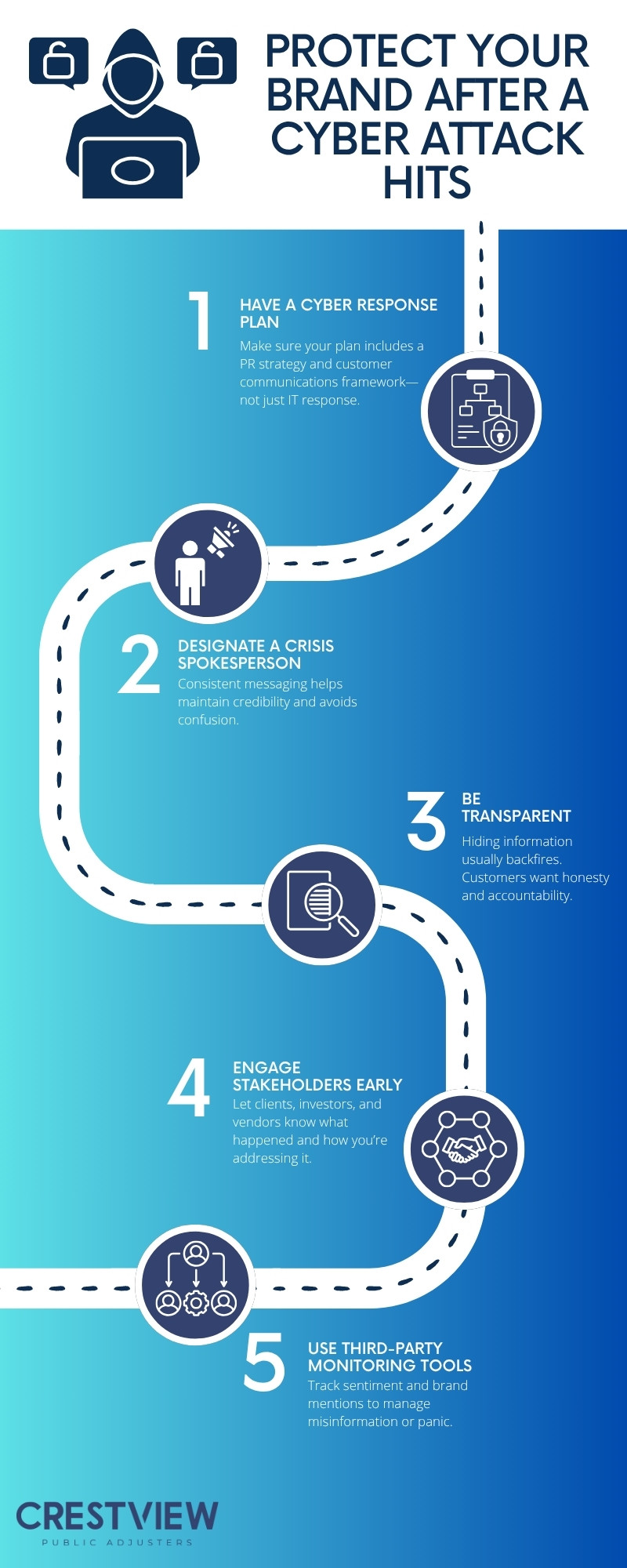
Even with the best crisis plan, though, reputational damage can occur. That’s why insurance and expert advocacy need to work hand-in-hand.
Claim What You’re Owed After a Cyber Attack
Don’t let your insurance company dictate the value of your brand’s reputation. If you’ve suffered a cyber breach and are now facing revenue loss, customer churn, or negative publicity, it’s time to seek professional help.
Protect Your Business Reputation — Contact Crestview Public Adjusters Today
Crestview Public Adjusters helps businesses in New Jersey, Florida, and New York navigate complex cyber insurance claims involving reputational damage. We specialize in securing compensation that truly reflects what your business lost—not just in data, but in trust and credibility.
Don’t leave money on the table. Let us represent your interests and fight for the full recovery your business deserves. Reach out today to schedule your free consultation.