
Key Points:
- Business interruption claims can cover lost income and extra expenses after a disaster, but the process is complex and highly scrutinized by insurers.
- Documentation, policy interpretation, and accurate financial data are critical to a successful claim.
- Working with a public adjuster early can help avoid common mistakes and maximize your recovery.
For many business owners, these disasters don’t just destroy buildings—they halt operations, cut off revenue streams, and put futures at risk. When the smoke clears or the floodwaters recede, the financial lifeline for many companies is their business interruption coverage. But filing a business interruption claim after a fire or flood isn’t as simple as notifying your insurance company.
Filing a Business Interruption Claim After a Fire or Flood: What You Need to Know
Filing a business interruption claim after a fire or flood involves proving income loss, interpreting your insurance policy correctly, and submitting detailed documentation. The claim process is often met with delays and pushback from insurers, making it vital to understand the steps involved and the challenges you might face.
This section explains the claim process in clear terms, identifies what insurers are really looking for, and shares how to avoid mistakes that could reduce your payout.
What Does Business Interruption Insurance Typically Cover?
Business interruption insurance doesn’t pay for the physical damage to your property. Instead, it reimburses you for income you lose when you’re forced to shut down temporarily.
Here’s what it often includes:
- Lost Net Income: Based on past financial records.
- Fixed Costs: Like rent, utilities, and payroll.
- Temporary Relocation Costs: If you move operations.
- Extra Expenses: Necessary costs to minimize downtime.
- Training Costs: If new equipment requires staff retraining.
But the extent of coverage depends on the language of your policy. For instance, many policies require a “direct physical loss” to trigger coverage—language that has led to countless disputes.
Insurers also look at your “period of restoration”, which is the estimated time to repair and reopen. If you take longer to reopen than deemed “reasonable,” your claim may be limited. That’s why documenting timelines, progress, and all decisions is essential from day one.
How Long Does It Take to Receive a Payout?
While most business owners hope for a quick payout, the reality is more complicated. Claims can take several months to over a year depending on:
- The complexity of the loss
- The accuracy of your documentation
- How responsive your insurer is
Some businesses see partial payouts early, with the rest delayed until forensic accountants verify lost income. Delays are common when policies are ambiguous, or when the business didn’t prepare adequate financial records pre-disaster.To keep your claim moving, stay on top of communication and requests for information. A public adjuster can also help manage this process more efficiently.
What Documentation Do You Need for a Business Interruption Claim?
This is one of the biggest hurdles in the claim process. Business interruption claims are data-heavy, and insurers will want detailed proof of how the disaster affected your finances.
You’ll need to gather:
- Pre-loss financial statements (12–24 months prior)
- Profit and loss statements
- Tax returns
- Sales and payroll records
- Rent or lease agreements
- Vendor and supply chain documentation
- Expense receipts tied to the event (repairs, relocation, etc.)
Make sure your financial records are organized and accessible. Your insurer will likely bring in their own accountants to scrutinize your numbers, so expect pushback and be ready to defend your data.
What Are Common Mistakes When Filing a Business Interruption Claim?
Even well-prepared businesses make errors that cost them time and money. Many of these mistakes are avoidable with the right guidance and awareness.
Avoid these common pitfalls:
- Waiting too long to file: Policies often have time limits, and delays can complicate verification.
- Relying solely on the insurance company’s adjuster: They represent the insurer, not you.
- Underdocumenting the loss: Vague or missing records lead to denied or reduced claims.
- Misunderstanding your policy language: Missing endorsements, exclusions, or time limits can derail your claim.
- Failing to track extra expenses accurately: These are often reimbursable but require strong proof.
Filing a business interruption claim after a fire or flood is not a passive process. It requires strategy, oversight, and a thorough understanding of what your policy says—and doesn’t say.
How Do Public Adjusters Help With Business Interruption Claims?
A public adjuster works for you, not the insurance company. They interpret your policy, calculate your business losses, assemble the documentation, and negotiate directly with the insurer.
Here’s how they make a difference:
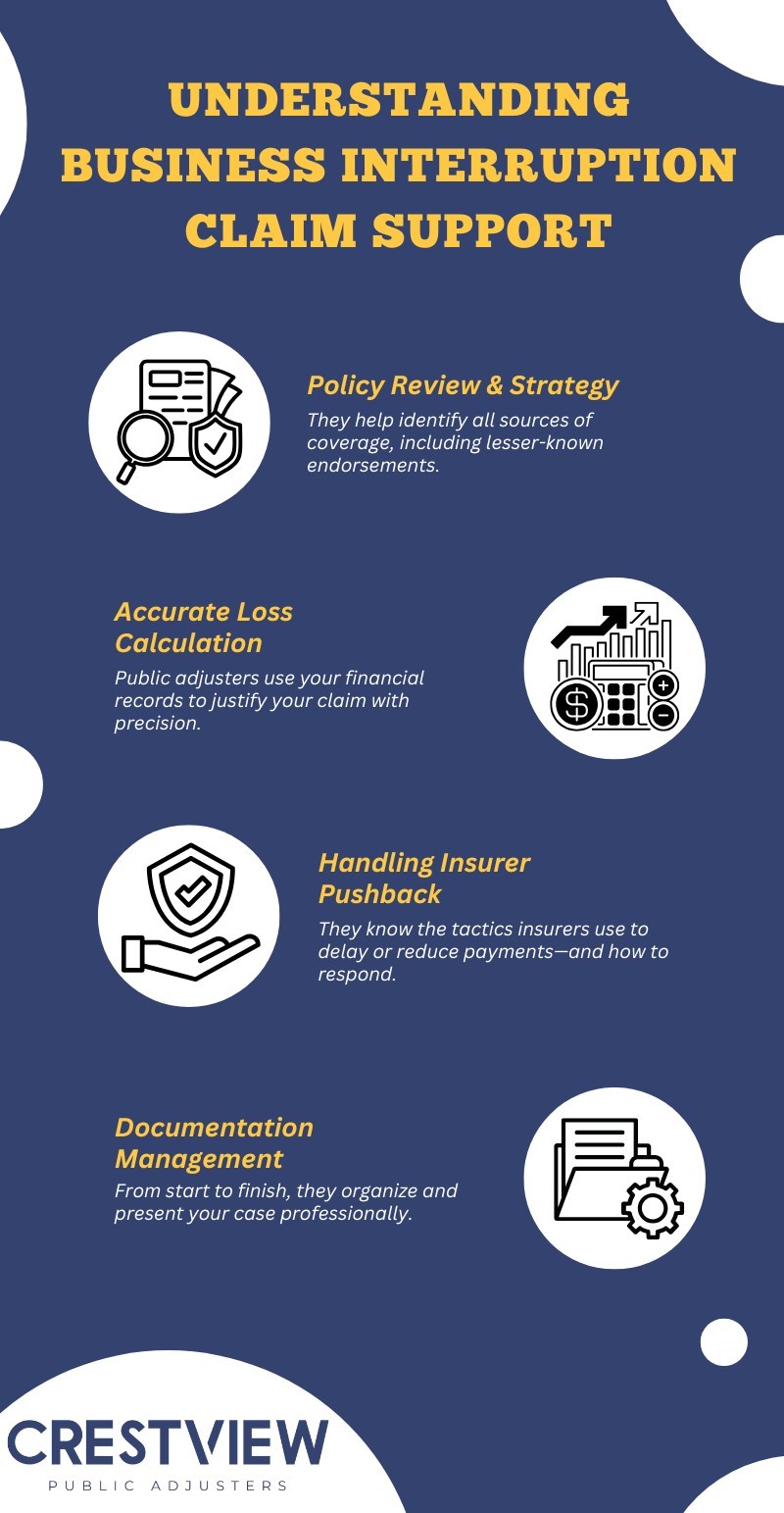
Many business owners engage a public adjuster when they feel overwhelmed or when the insurance company starts challenging their numbers. But involving them early—ideally before filing—can prevent costly errors and accelerate resolution.
Can You Get Denied Even If You Have Coverage?
Yes, and it happens more often than business owners expect. A claim can be denied or underpaid for several reasons, including lack of physical damage as defined by the policy, excluded perils such as floods that aren’t separately covered, poor documentation, missed filing deadlines, or disputes over how the policy is interpreted.
Even with valid coverage, insurers often lean on ambiguous policy language to favor their own interests. That’s why strong documentation and a clear, consistent narrative are critical. When the stakes are high, having a public adjuster advocate for your rights can be the difference between receiving a full payout and having your claim denied.
How Can You Maximize Your Business Interruption Claim?
If you’re serious about getting compensated fairly, it’s not enough to simply notify your insurer. Proactive planning and clear execution are key.
To maximize your claim:
- Act fast: Notify your insurer immediately and begin documenting.
- Understand your policy: Don’t rely on assumptions—read the fine print.
- Track everything: From lost income to new expenses, record it all with timestamps and receipts.
- Document repairs and timelines: These help define your “period of restoration.”
- Bring in help: A public adjuster can assess, quantify, and present your claim in the best possible light.
Business interruption coverage is a powerful tool, but it only works if used correctly. Filing a business interruption claim after a fire or flood requires discipline, awareness, and sometimes, professional assistance.
Hire Experts to Handle Your Claim With Precision
Need help navigating your business interruption claim? At Crestview Public Adjusters, we help policyholders recover lost income and expenses after disasters in New Jersey, Florida, and New York. Our team brings years of expertise in preparing and negotiating business interruption claims—so you don’t have to go it alone.
We don’t work for insurance companies. We work for you. From fire damage to flood-related closures, our licensed public adjusters manage every part of the claims process to get your business back on track faster and with less stress.
Let’s make your claim stronger. Contact us today to get started.