
Key Points:
- A lightning strike insurance claim can be supported without visible burn marks by connecting the storm to each equipment failure.
- Strong proof includes a precise timeline, location-based weather records, specialist findings, surge-route mapping, and pre-storm operating records.
- Preserved parts and one organized causation package help explain the loss.
A New York lightning strike insurance claim can still have strong support when the roof, siding, and outlets show no burn marks. The file must connect the storm to the property through timing, lightning-location records, specialist findings, a mapped failure pattern, and preserved parts.
Lightning can reach equipment through power wiring, communication lines, metal systems, or a nearby connection. Connected devices may fail without an obvious strike point.
At Crestview Public Adjusters, we link each failed system to the date, location, and suspected electrical route. Our Old Westbury claim showed why visible damage can mislead. Lightning reached a rooftop gas vent, caused a basement fire, and left smoke damage throughout the home.
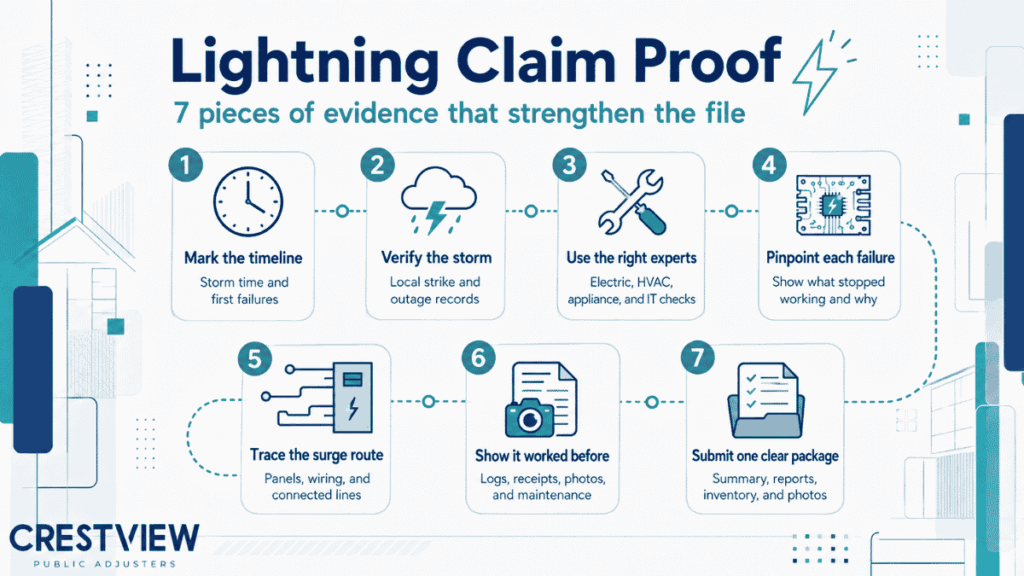
Step 1: Build a Precise New York Storm and Failure Timeline
When filing a lightning damage claim, relying on memory days after the storm creates gaps that insurers notice. You need to log details as soon as possible.
Make sure to write down:
- The exact storm date and closest known time
- The moment lights flickered, breakers tripped, alarms sounded, or power cut out
- Any loud thunderclap, flash, structural vibration, smoke odor, or outlet popping sound
- The first time each appliance, system, or circuit stopped responding
- Nearby utility outages, blown transformers, or downed lines
- Statements from tenants, employees, neighbors, or building staff
- Timestamps from security cameras, smart hubs, or doorbells
How New York Weather Records Support a Lightning Strike Insurance Claim
Gathering independent weather data creates a factual anchor for your storm damage claim. A general thunderstorm forecast carries little weight, but official data tied to your property’s exact coordinates helps prove a storm occurred when your equipment failed.
You can build a solid foundation by collecting:
- Lightning summaries from the National Centers for Environmental Information (NCEI)
- A certified strike report showing cloud-to-ground activity near your latitude and longitude
- National Weather Service local storm reports for your specific county
- Local utility outage event numbers and response logs
- Fire department incident responses or emergency call logs
- Timestamped video footage or photos from surrounding security systems
- Written statements from eyewitnesses who saw or heard the strike
Weather reports establish that a plausible strike occurred near your address. They do not diagnose broken equipment, but they give your technical reports the background context needed to support a lightning strike insurance claim.
Step 3: Request Written Findings From the Right Specialists
A short repair estimate stating power surge is rarely enough to support an insurance claim. You need diagnostic reports from qualified technicians who examine individual failure mechanisms.
Separate your service calls across these fields:
- A licensed electrician to evaluate the service entrance, main panel, grounding rods, breakers, branch circuits, outlets, and building wiring
- A heating, ventilation, and air conditioning (HVAC) contractor to test boilers, furnaces, heat pumps, digital thermostats, compressors, and control boards
- An appliance technician to inspect refrigerators, wall ovens, dishwashers, washers, and built-in equipment
- An information technology (IT) specialist to examine desktop computers, servers, switches, routers, security cameras, and network devices
- A fire investigator or engineer if you suspect internal arcing, heat damage, or ignition points
What a Lightning Strike Insurance Claim Report Should State
Every technician report should include:
- The item’s make, model, and serial number
- The specific circuit board, relay, or component that failed
- The physical diagnostic tests performed on site
- The observed electrical conditions and internal readings
- A statement on whether the failure pattern fits a sudden surge
- An evaluation ruling out normal wear, age, or mechanical defect
- A clear determination on whether repair or replacement is needed
- The inspection date, technician license number, and signature
Multiple failed systems can lead to conflicting trade reports when contractors look at single devices in isolation. At Crestview Public Adjusters, we review your storm timeline, property records, specialist findings, and structural damage patterns as one unified file. Reach out to our team and send us your available records before discarding or replacing key equipment.
Step 4: Map the Surge Route Beyond the First Failed Device
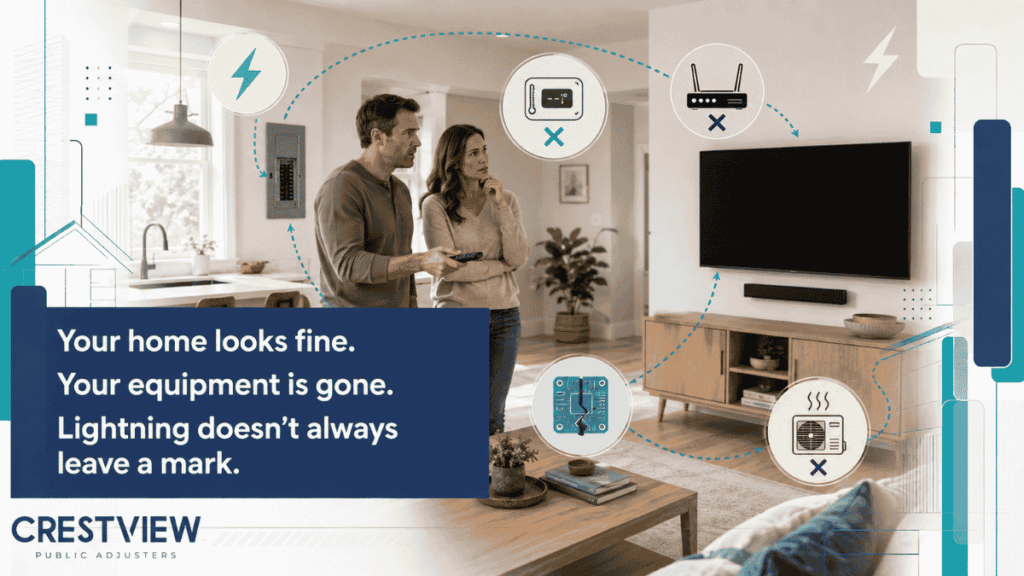
Electrical surges do not move in straight lines. When a high-voltage charge hits a structure, it travels along every conductive wire available.
To support a lightning surge damage claim, you should map every connected route across your property:
- Main electrical service cables and interior branch circuits
- Coaxial, Ethernet, telephone, satellite, and fiber optic lines
- Alarm system wiring and sensor loops
- Low-voltage HVAC control wiring
- Automatic gate and garage door opener circuits
- Exterior landscape lighting and irrigation control modules
- Smart switches, connected hubs, and security cameras
- Solar array inverters, backup generators, and electric vehicle chargers
- Commercial point-of-sale terminals, refrigeration monitors, and server racks
Mapping these connected routes helps distinguish a surge case from a lightning strike fire claim.
In one electrical loss case we managed, the initial damage appeared limited to a single hallway light fixture. When we expanded the inspection along connected circuits, we traced smoke and internal heat damage into several adjacent apartments, wall cavities, and HVAC ductwork. Taking a property-wide view prevents your inspection from stopping at the first dead appliance.
Step 5: Create an Item-by-Item Damage Inventory
Grouping damaged electronics into a general list creates delays. Creating a detailed inventory sheet keeps your claim organized and easy to evaluate.
Build a spreadsheet with these columns:
- Room or business location
- Detailed item description
- Manufacturer, model number, and serial number
- Purchase date or estimated age
- Original receipt, bank statement, or order history reference
- Pre-storm operating condition
- Exact date and time the failure was noticed
- Connected outlet, breaker panel, or network line
- Specialist diagnostic finding
- Repair or replacement status
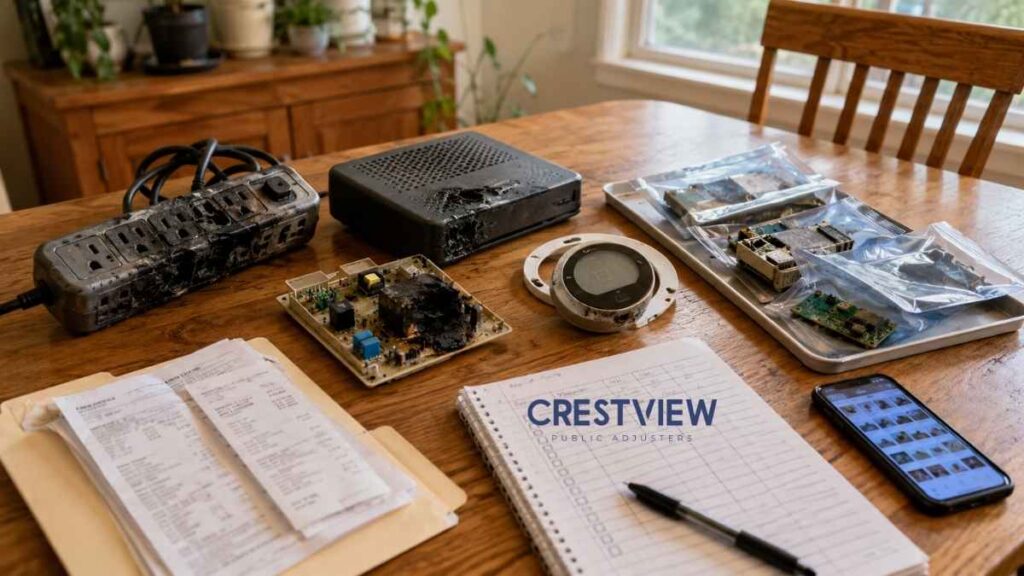
- Photos of the unit and its internal burnt boards or ports
If you have custom-built computers, detail each internal component separately, including the power supply, motherboard, processor, and graphics card. For smart home networks, list how individual hubs, switches, and sensors link together.
Step 6: Preserve Evidence That Shows the Equipment Worked Before the Storm
Insurers frequently question whether old equipment failed due to age or previous wear rather than a sudden event. Demonstrating proper function right up to the storm helps resolve these questions.
Gather pre-storm operating records such as:
- Recent contractor maintenance invoices
- Equipment installation receipts and warranty documents
- System activity logs from routers, servers, or smart thermostats
- Security camera footage showing operational lights or indicators
- Photos or videos taken inside the property shortly before the storm
- Service contracts for HVAC units, generators, or elevators
- Statements from building staff, tenants, or regular users
- Diagnostic logs from home automation hubs or alarm systems
Carrying homeowners insurance for lightning damage means you may face questions about maintenance history. Showing that your equipment operated normally right before the weather event prevents insurers from labeling the loss as gradual wear.
Step 7: Submit One Causation Package Instead of Separate Documents
Sending piecemeal receipts and invoices to your insurer often leads to confusion and delayed decisions. Presenting your proof as a single structured package makes the cause clear from day one.
Organize your submission in this exact order:
- A one-page executive event summary
- Official storm weather records and certified strike reports
- Property timeline listing all observed failures
- Master electrical inspection report
- Trade specialist reports grouped by equipment type
- Diagram or map showing the suspected surge route
- Detailed itemized damage inventory
- Photo and video documentation with timestamps
- Proof of pre-storm operating condition
- Repair estimates and preserved parts inventory
- Log of all written communication with the insurer
Working with a public adjuster for lightning damage allows you to verify that every specialist report aligns with the physical evidence before sending it in. Avoid submitting random receipts without explaining how each piece fits the overall storm timeline and voltage route.
FAQs About a Lightning Strike Insurance Claim
Does insurance cover lightning damage if the strike hit nearby property?
Coverage depends on your policy terms, but nearby strikes often send high voltage through utility, phone, or ground wires into neighboring structures. Your proof must show local lightning activity, prompt equipment failures, and specialist reports confirming surge damage.
What should I do if another device fails days later?
Photograph the device, note the date, disconnect it safely, and update your failure timeline. We handled a New York storm claim where later testing revealed hidden HVAC control damage days after the initial floor inspection. Each late failure needs clear technical support.
Who should inspect a custom computer or security system?
An IT specialist should test individual internal components, logic boards, and network ports. A licensed electrician should test the building outlets and breaker panels. We cross-reference both reports to verify that both technicians evaluated the exact same surge route.
Document Your New York Lightning Loss Before Evidence Changes
Proving a lightning claim without burn marks requires clear, connected evidence rather than a single dramatic photo. Official weather records, a detailed timeline, trade diagnostic reports, and preserved physical parts work together to demonstrate how electrical energy damaged your property.
Crestview Public Adjusters assists homeowners, property owners, and business operators across New York, including New York City, Buffalo, Rochester, Syracuse, Albany, the Finger Lakes, and the Capital District. Call (551) 316-7204 or submit our contact form with your storm date, property address, damaged item list, photos, claim number, and available specialist reports. Our team will review your file and help you identify the exact evidence needed next.