
Key Points:
- Handle a partial loss fire insurance claim by documenting all damage, including smoke and hidden effects, and creating a room-by-room inventory with receipts, samples, and photos.
- Build a repair scope that restores pre-loss condition, including cleaning, replacements, and code upgrades.
- Fast, detailed proof helps secure full compensation.
When a fire causes partial damage, many homeowners face confusion about what qualifies for coverage. You might wonder: will your insurer cover smoke damage even if the structure isn’t fully destroyed? Or how do you prove the cost of partial repairs and lost contents?
This guide goes into the specifics of managing a partial loss fire insurance claim. You’ll find steps that help you get the full scope of compensation you deserve, without needing to look elsewhere.
Understand “Partial Loss” So the Scope Matches the Real Damage
A partial loss fire insurance claim means the home is repairable, yet far more is affected than what’s visibly burned.
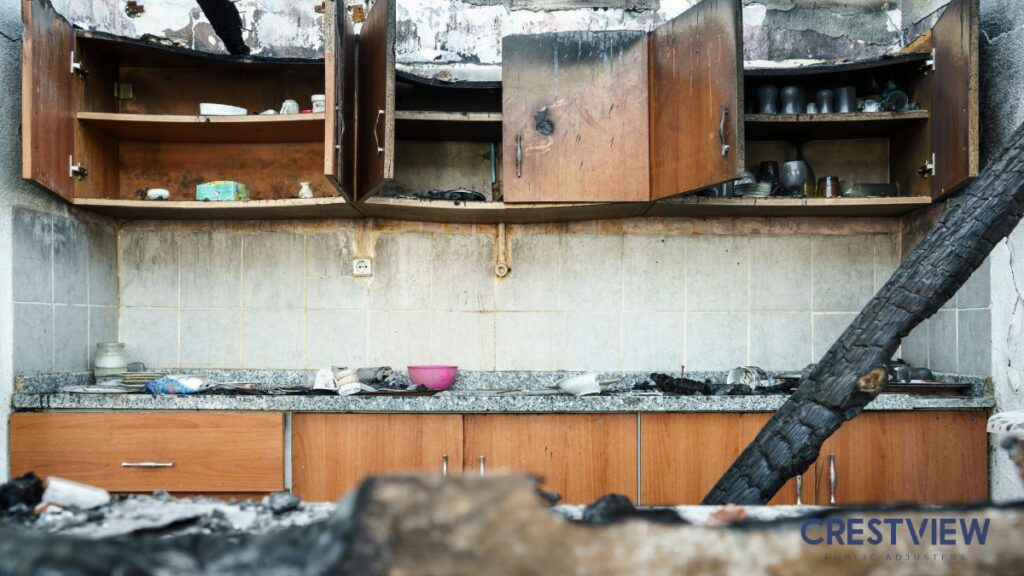
Kitchen fires often leave a structure that looks ‘mostly fine’ but hide smoke damage on cabinets, drywall, and contents. In 2023, the U.S. fire administration estimated 344,600 residential building fires, with cooking as the leading cause (48.7%). This is a pattern that frequently results in partial, not total, losses.
Policy coverage sets the guardrails. Most homeowners policies pay replacement cost value (RCV) on buildings after work is complete and pay actual cash value (ACV) upfront, with depreciation withheld. Contents may be ACV by default unless you purchased replacement cost for personal property.
The practical goal is simple: build a scope that restores the structure and contents to pre-loss condition. That scope must account for the following:
- Cleaning
- Sealing
- Painting
- Replacing damaged assemblies
- Remediating odor
- Addressing electrical and mechanical components
- Adding code upgrades where required
First 72 Hours: Actions That Protect the Claim (And Your Living Conditions)
Those first days set the foundation for the entire claim. Safety comes first. Once the scene is cleared, follow a “what to do after a fire” plan and start a clean paper trail
Make sure that you limit further damage while preserving evidence to avoid common denial reasons. When you meet the carrier’s adjuster, walk the property systematically. Start outside, move room by room, look at the attic, and then the crawlspace or basement.
Here’s a simple working list for the first 72 hours:
- Create the claim file. Photos, videos, emergency invoices, mitigation logs, and a call log in one place
- Preserve samples. Keep labeled baggies of flooring, countertop chips, cabinet doors, and trim for matching.
- Capture systems. Photograph the electrical panel, HVAC air handler and coils, returns, and registers, plus any corrosion on appliances and electronics.
A structured start reduces disputes later and sets up your supplements when new damage is uncovered during repairs.
How to Make an Itemized List for an Insurance Claim
Contents and materials drive a big part of a partial loss. An inventory that’s vague will slow settlement; an inventory that’s specific will move it forward. Think line-by-line detail: what it is, where it was, brand/model, condition, quantity, unit price, and tax.
Begin with a room-by-room sweep. Use your photos as a checklist and write down every affected item, including what looks “cleanable.”
Decide between clean vs. replace with a method. Hard goods with etched finishes, warped panels, or heat-affected laminates usually don’t restore well. Porous fabrics with embedded odor may need replacement, while some leather or wood pieces respond to specialty cleaning. If in doubt, ask the restorer to document pre- and post-cleaning odor and residue readings.
Build the spreadsheet with columns that match the carrier’s expectations:
- Location and category. E.g., “Kitchen—Upper Cabinets,” “Living Room—Area Rug.”
- Make/model and description. Include sizes, finish names, and serial numbers.
- Price basis. Link to a current price, add sales tax, and note any delivery or setup costs.
For contents that are a total loss, add photos showing the damage and include a brief reason like “soot etched,” “smoke odor remains after cleaning,” or “heat delamination.” When totals are large, add a short summary tab by room. Clarity here reduces back-and-forth and prevents arbitrary reductions.
Estimating the Building Scope: Cleaning, Replacement, and Code Triggers
Building scope disputes arise when insurers push cleaning and contractors push replacement. Focus on what restores pre-loss conditions and avoid an underpaid fire claim.
Quick checklist:
- Cabinets: Replace elevation/room if matching is impossible.
- Flooring: Replace continuous runs, not scattered patches.
- Smoke/Odor: Remove source, then seal.
- HVAC: Clean coils, replace ducts/filters.
- Electronics: Test for corrosion before deciding.
- Code: Factor in GFCIs, alarms, ventilation.
Industry data show that fire and lightning claims have the highest average severity among homeowners’ losses at about $83,991 (2018–2022 weighted average), which explains why partial losses require detailed scopes and vigilant supplements.
Avoid the Most Common Pitfalls in Partial Loss Fire Claims
Partial losses can turn into repeat repairs if odor returns, finishes don’t match, or hidden damage was missed. These preventable mistakes show up again and again. A little structure goes a long way.
Here’s what you must do:
- Avoid discarding damaged items before the adjuster documents them. If wet drywall or charred materials must be removed for safety, save labeled samples and extra photos.
- Do not rely on paint alone to “cover” smoke odor; ask restorers to show the cleaning steps and products before sealing.
- Ensure any cleaning warranties are in writing and tied to measurable outcomes (odor thresholds, particulate readings), not just “satisfaction.”
- Keep the itemized list updated daily. When you buy replacements, save every receipt and add tax and delivery. If you’re displaced, Additional Living Expenses (ALE) should track lodging, meals (with reasonable daily limits), laundry, and extra mileage to work or school.
- Respond to carrier requests quickly and in writing. If a proof-of-loss is requested, meet the deadline and reference the inventory totals.
Finally, invest a few minutes in safety as you reoccupy. Data consistently show the life-safety value of alarms. Working smoke alarms cut the risk of dying in a home fire by around 60%, a strong reminder to install fresh units and test them after repairs.

Frequently Asked Questions
What is partial loss in an insurance claim?
Partial loss in an insurance claim means property is damaged but not destroyed, and repairs do not exhaust policy limits. The insurer pays to repair or replace only the damaged parts, subject to limits and deductibles. This contrasts with total loss, where the property is fully destroyed or limits are reached.
What type of loss can be compensated by fire insurance?
Fire insurance compensates for direct physical loss from fire, including damage to the dwelling, other structures, personal property, and smoke. Wildfire losses are also covered. Policies may reimburse Additional Living Expenses if the home becomes uninhabitable, subject to policy terms, limits, and exclusions.
What are the conditions required for a loss by fire claim?
A loss by fire claim requires that fire, a covered peril, directly causes the damage. The insured must have an insurable interest in the property. Policies require prompt notice, steps to protect property, cooperation with the insurer, and submission of a sworn proof of loss within deadlines.
Submit Your Claim with Professional Support
Public adjusters and claims management services in Florida, New York, and New Jersey can be the difference between a partial payout and full recognition of your losses. These services ensure your documentation is complete, your demand letter is persuasive, and your claim reflects the true cost of smoke, structure, and living expenses.
Crestview Public Adjusters brings the expertise policyholders need during partial fire loss claims. Contact us today to discuss your situation and take the next step toward a fair settlement.