
Key Points:
- A named storm deductible applies to qualifying storm damage under the policy and applicable state rules.
- New York’s homeowners hurricane trigger requires landfall in the state, while New Jersey’s requires hurricane designation and qualifying sustained winds measured within the state.
- A percentage deductible commonly uses the dwelling coverage limit.
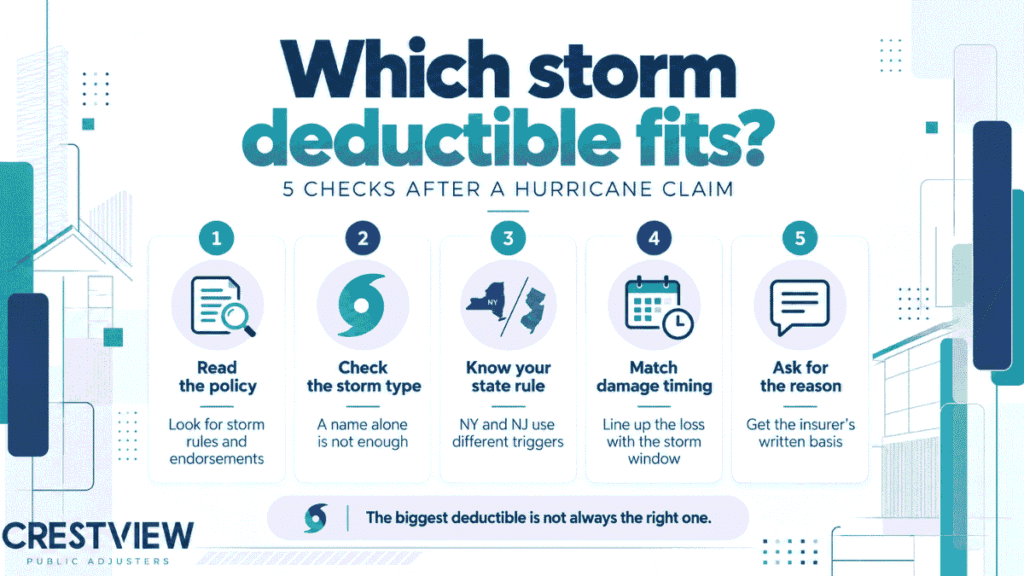
A named storm deductible applies only when the damage meets the policy’s storm conditions and applicable state rules. A storm’s name alone does not establish that a hurricane deductible applies in New York or New Jersey. The policy wording, storm classification, and timing of the damage all need review.
The Atlantic hurricane season ends on November 30. For owners reviewing a storm claim, the question may now concern a deductible listed in the insurer’s estimate. At Crestview Public Adjusters, we provide hurricane and storm claim support that includes policy review, damage documentation, and communication with the insurer.
What Does a Named Storm Deductible Mean?
A deductible is the portion of a covered loss that the policyholder is responsible for. A named storm deductible is a separate deductible for damage caused by storms that meet the policy’s definition.
Several deductible labels may appear in a property policy:
- Standard deductible: Applies to covered losses unless a separate deductible takes its place.
- Hurricane deductible: Applies when the required hurricane conditions occur.
- Named storm deductible: May include tropical storms and other qualifying named systems.
- Windstorm or wind/hail deductible: May apply to wind or hail damage without a hurricane.
The differences between storm deductibles depend on their triggers. A trigger is the condition that activates a deductible. It may involve storm classification, wind measurements, location, or a stated period.
A policy endorsement, which changes the policy’s terms, should explain those conditions. The declarations page usually lists the deductible amount or percentage, but that page alone may not explain when it applies.
How Does a Hurricane Percentage Deductible Work?
A hurricane percentage deductible commonly uses the home’s Coverage A limit, which is the amount of dwelling insurance. The percentage does not necessarily apply to the repair estimate.
Hypothetical example: A home has a $400,000 Coverage A limit and a 2% hurricane deductible based on that limit. The deductible would be $8,000 because $400,000 × 0.02 = $8,000. That calculation identifies the deductible; it does not establish coverage for the damage.
The New Jersey homeowners insurance guide describes percentage deductibles based on Coverage A. The exact calculation still depends on the policy.
Before another storm, a hurricane insurance checklist can help you record each deductible and locate the endorsements that explain it.
When Does a Hurricane Deductible Apply in New York?
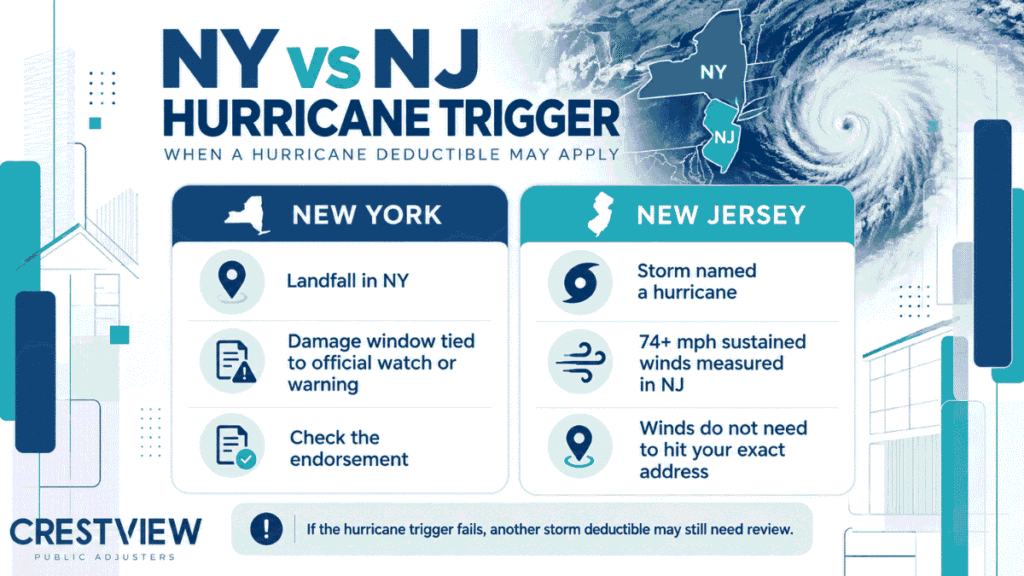
For New York homeowners insurance, the hurricane must make landfall in the state before the hurricane deductible can trigger. The New York Department of Financial Services also identifies a specific period for qualifying wind damage.
That period begins 12 hours before the hurricane makes landfall in New York. It ends 12 hours after the weather authority cancels its final hurricane watch or warning for the state concerning that storm.
A news report calling an event a hurricane does not establish that these conditions occurred. The claim review needs the official storm record and the applicable endorsement. A separate windstorm deductible may still need review if the hurricane trigger did not occur.
How Is the Hurricane Deductible Different in New Jersey?
New Jersey’s homeowners hurricane deductible requires an event designated as a hurricane by the National Weather Service. Sustained winds of at least 74 mph must also have been measured somewhere in New Jersey.
Those winds do not have to reach your particular property. A wind gust recorded near the home is different from the sustained-wind measurement used in the state’s hurricane requirements. New Jersey’s standard hurricane deductible language makes that statewide distinction.
New Jersey policies may also carry a separate windstorm or hail deductible. The absence of a qualifying hurricane therefore does not automatically mean the standard deductible applies. Each provision needs its own review.
Which Deductible Applies to the Storm Claim?
The applicable deductible comes from matching the covered cause of damage with the policy’s conditions. The largest listed deductible does not automatically control, and the smallest one is not automatically available.
| Situation | Policy Item to Check | Deductible That May Apply |
|---|---|---|
| The hurricane trigger occurred and the policy includes a hurricane deductible | Hurricane endorsement, declarations page, and applicable state requirements | Hurricane deductible |
| The hurricane trigger did not occur, but a separate wind provision applies | Windstorm or wind/hail endorsement | Windstorm or wind/hail deductible |
| The policy includes broader named-storm terms | Named-storm definition, endorsement, and applicable state requirements | Named storm deductible |
| No separate storm deductible applies to the covered damage | Base policy and declarations page | Standard deductible |
The wind deductible versus standard deductible question turns on the wording, not simply the storm’s strength. A strong unnamed windstorm could fall under a wind deductible, while a named tropical system still requires review of its specific terms.
Coverage remains a separate question. A deductible provision identifies the policyholder’s share of covered damage; it does not make excluded damage covered.
Which Records Help Check the Insurer’s Deductible?
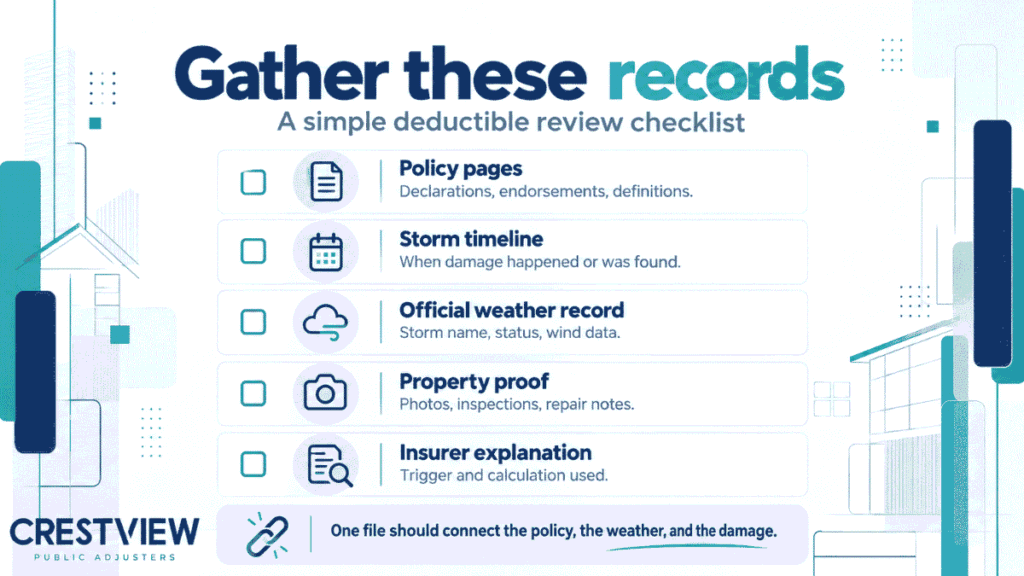
The claim file should connect three things: the policy provision, the qualifying weather event, and the damage. A deductible percentage without that connection leaves part of the explanation missing.
The main records include:
- The policy in effect on the loss date: Declarations, deductible endorsements, and definitions.
- A damage timeline: When the damage occurred, when someone discovered it, and what remains uncertain.
- Official storm records: Classification, landfall information, warnings, and relevant wind measurements.
- Property evidence: Dated photographs, inspection findings, temporary repair records, and contractor reports.
- The insurer’s written explanation: The provision, trigger, and calculation used in the claim.
Discovery time and damage time may differ. A ceiling stain noticed the next morning does not establish the exact hour that rain entered. An accurate timeline should identify that uncertainty without assigning an unsupported time.
Property records answer a separate question from weather records. During our roof damage inspection in Hohokus, New Jersey, possible tropical storm damage was not visible from the street. Our team used a drone and located missing shingles. That finding documented roof damage; it did not, by itself, establish which deductible applied.
Earlier roof and gutter maintenance records can also help explain the property’s condition before the loss. Professional inspections should handle areas that owners cannot reach safely.
What If the Insurer’s Explanation Is Incomplete?
A written request can ask the insurer to identify the deductible endorsement, the event conditions it relied on, and the calculation. A response that only says “named storm” may leave those questions unanswered.
For example, a percentage calculation may be correct even when the reason for selecting that deductible remains uncertain. The calculation and the trigger need separate checks.
Our storm claim work includes reviewing policy terms alongside inspection findings and repair estimates. We represent the policyholder, while the insurer’s adjuster works for or on behalf of the insurance company. Our team can organize the relevant records and discuss a documented disagreement with the carrier.
FAQs About Named Storm Deductibles
Can a named storm deductible apply more than once in a year?
Yes, depending on the policy. A named storm deductible may apply per event, per season, or per calendar year. Two storms during one coverage period could therefore involve separate deductibles. The frequency terms in the endorsement determine how the policy handles multiple events.
Does a named storm deductible include flood or storm surge coverage?
No. A named storm deductible does not add flood coverage to a homeowners policy. Flood and storm surge generally require separate flood insurance. Our explanation of storm water damage versus flood insurance covers the water-source questions that can arise during the same event.
Do these homeowners rules also apply to a commercial building?
Commercial owners should review their own policy forms and endorsements. The state comparison above addresses homeowners insurance. A business property’s deductible may use different definitions or calculation terms, so an owner should not transfer a homeowners rule to a commercial claim without checking the contract.
Review the Deductible Applied to Your Storm Claim
A storm deductible review should connect the policy’s trigger with the weather record and the damaged property. Any disagreement needs to identify the specific provision or fact that requires another look.
At Crestview Public Adjusters, we help New York and New Jersey property owners review storm claim documents and communicate with insurers. A free claim assessment gives you a place to discuss the deductible explanation, policy pages, and damage records you already have.
Our team can help you understand the deductible applied to your claim.